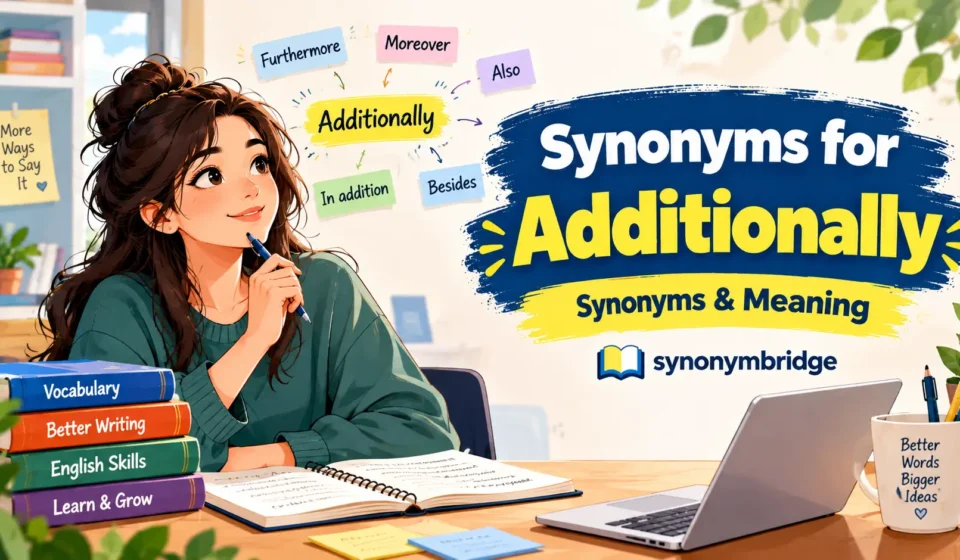
A good synonym for “additionally” is “furthermore,” “moreover,” or “also.” These words add one more idea to a sentence. Use these synonyms for additionally when you want to join facts smoothly, avoid repeating the same word, and make your writing sound clear and polished.
Maya read her essay out loud and frowned. The word “additionally” appeared four times in one page. Her teacher would notice. She needed fresh words, fast.
“The difference between the almost right word and the right word is really a large matter.” Mark Twain
Here is an easy example: “I love pizza. Additionally, I love pasta.” Now see how “plus” or “besides” can replace it without changing the meaning.
Why does this matter? Students can score better in essays. Bloggers can keep readers interested. Content writers can sound professional. Daily English users can speak more naturally.
“Words are, of course, the most powerful drug used by persons.” Rudyard Kipling
Let’s explore 55 simple options.
1. Also
- Meaning: Used to add another fact or idea in a simple way.
- Examples: I like tea. I also like coffee. She also finished her homework early.
2. Furthermore
- Meaning: Used in formal writing to add a stronger extra point.
- Examples: The plan is cheap. Furthermore, it is very quick. He is kind. Furthermore, he is always on time.
3. Moreover
- Meaning: Used to add a new point that supports your main idea.
- Examples: The park is clean. Moreover, it is free. This phone is light. Moreover, its battery lasts long.
4. In addition
- Meaning: A common phrase that adds one more fact to the list.
- Examples: In addition, we need more chairs. In addition, the team won two awards.
5. Besides
- Meaning: Adds another reason, often in a casual way.
- Examples: Besides, it is too late to go. Besides, I already paid for it.
6. Plus
- Meaning: A casual word that adds a bonus point to your sentence.
- Examples: The hotel is cheap. Plus, breakfast is free. Plus, the staff is friendly.
7. Likewise
- Meaning: Shows that a new idea is similar to the last one.
- Examples: Ali cleaned his room. Likewise, Sam cleaned his. She smiled, and I smiled likewise.
8. Similarly
- Meaning: Connects two ideas that are alike in some way.
- Examples: Dogs need walks. Similarly, puppies need daily exercise. Similarly, cats enjoy playing outside.
9. Too
- Meaning: Adds an idea at the end of a short sentence.
- Examples: I want some cake too. He plays guitar too.
10. As well
- Meaning: Another casual way to say “also” at the end.
- Examples: We bought apples and grapes as well. She sings and dances as well.
11. What’s more
- Meaning: Adds an even more interesting point to your talk.
- Examples: The movie was fun. What’s more, it was short. What’s more, tickets were cheap.
12. On top of that
- Meaning: Adds one more thing, often to a long list.
- Examples: I missed the bus. On top of that, it started raining.
13. Equally important
- Meaning: Shows the next point matters just as much.
- Examples: Sleep is key. Equally important, you should eat well. Equally important, drink enough water.
14. Further
- Meaning: Adds more detail in a formal or serious way.
- Examples: Further, the report shows a clear result. Further, we need more time to check.
15. Not to mention
- Meaning: Adds a point that is already easy to believe.
- Examples: The cake looks great, not to mention the taste. It is cheap, not to mention useful.
16. Beyond that
- Meaning: Moves to a point past the one you just made.
- Examples: Beyond that, I have no questions. Beyond that, the room was perfect.
17. Along with that
- Meaning: Joins a new idea to something already said.
- Examples: Along with that, bring your ID card. Along with that, we got free snacks.
18. By the same token
- Meaning: Used in formal talk to add a fair, matching point.
- Examples: He should get credit. By the same token, so should she.
19. In the same way
- Meaning: Shows a new idea works like the earlier one.
- Examples: Birds need rest. In the same way, we need sleep.
20. Correspondingly
- Meaning: Shows one change matches another change.
- Examples: Prices went up. Correspondingly, fewer people bought tickets.
21. Over and above
- Meaning: Adds something extra beyond what was needed.
- Examples: Over and above her pay, she got a bonus. He did over and above his duty.
22. Alongside this
- Meaning: Adds a second idea that happens at the same time.
- Examples: Alongside this, we will host a small contest. Alongside this, she studies French.
23. Together with this
- Meaning: Joins two facts into one stronger point.
- Examples: Together with this, the price makes it a great deal.
24. Apart from this
- Meaning: Adds a point that is outside the main topic.
- Examples: Apart from this, the trip went well. Apart from this, I felt fine.
25. Aside from that
- Meaning: Adds a small extra point in a casual voice.
- Examples: Aside from that, the food was good. Aside from that, nothing else broke.
26. Not only that
- Meaning: Builds excitement before adding a bigger fact.
- Examples: Not only that, she won first prize. Not only that, the kids loved it.
27. Even more
- Meaning: Shows the next idea is stronger than the last.
- Examples: Even more, the team gave extra help. Even more, the show was free.
28. Another point
- Meaning: Clearly tells the reader a new idea is coming.
- Examples: Another point is the high cost. Another point to note is the weather.
29. Also worth noting
- Meaning: Highlights a useful fact that readers should remember.
- Examples: Also worth noting, the store closes early. Also worth noting, parking is free.
30. Add to that
- Meaning: A friendly way to stack one more fact.
- Examples: Add to that, the room had a lovely view. Add to that, dinner was great.
31. And
- Meaning: The simplest word to join two ideas together.
- Examples: I cooked rice, and she made soup. He reads, and he writes.
32. Coupled with this
- Meaning: Joins two facts to show a bigger result.
- Examples: Coupled with this, rent keeps rising every year. Coupled with this, jobs are scarce.
33. In like manner
- Meaning: A formal phrase showing two actions are alike.
- Examples: She thanked her guests. In like manner, he thanked his team.
34. Equally
- Meaning: Shows the new point is just as strong.
- Examples: Equally, we must respect each other’s time. Equally, practice builds skill.
35. Following that
- Meaning: Adds a step that comes after the last one.
- Examples: Following that, we ate dinner. Following that, the class began.
36. Next
- Meaning: Moves to the second idea in a simple list.
- Examples: Next, add two eggs to the bowl. Next, we visited the museum.
37. Then
- Meaning: Adds a new action that comes right after.
- Examples: First I woke up. Then I made tea. Then she called me.
38. Again
- Meaning: Repeats or adds a point that was said before.
- Examples: Again, safety comes first. Again, the answer is simple.
39. Just as important
- Meaning: Tells readers the next point deserves equal attention.
- Examples: Just as important, keep your notes tidy. Just as important, ask questions often.
40. To add to this
- Meaning: A polite way to give one more thought.
- Examples: To add to this, the book has pictures. To add to this, it is short.
41. Adding to this
- Meaning: Smoothly stacks a new fact on top of another.
- Examples: Adding to this, the weather was sunny. Adding to this, the roads were empty.
42. To top it off
- Meaning: Adds a final surprise, good or bad, to a story.
- Examples: To top it off, we won a trip. To top it off, my phone died.
43. Better still
- Meaning: Adds an idea that is even nicer than before.
- Examples: The cake is soft. Better still, it is homemade. Better still, it costs little.
44. Not forgetting
- Meaning: Reminds readers of one more thing in a list.
- Examples: We thanked the cooks, not forgetting the drivers. Not forgetting Sara, our helper.
45. In a similar way
- Meaning: Compares a new idea with the earlier one.
- Examples: In a similar way, plants need sunlight. In a similar way, kids learn through play.
46. Along the same lines
- Meaning: Adds a thought that follows the same idea.
- Examples: Along the same lines, she wants a smaller office. Along the same lines, we need quiet.
47. In the same vein
- Meaning: Adds an idea with the same mood or style.
- Examples: In the same vein, he told another joke. In the same vein, we sang again.
48. On a related note
- Meaning: Moves to a topic that connects to the last one.
- Examples: On a related note, sleep helps memory. On a related note, we need snacks.
49. At the same time
- Meaning: Adds a second idea that is true together.
- Examples: She is strict. At the same time, she is kind. He studies and works at the same time.
50. In further support
- Meaning: Adds proof that makes your main point stronger.
- Examples: In further support, the survey shows clear results. In further support, experts agree.
51. Another thing
- Meaning: A casual way to introduce one more idea.
- Examples: Another thing, please lock the door. Another thing, bring a warm jacket.
52. In addition to this
- Meaning: A slightly longer form of “in addition” for emphasis.
- Examples: In addition to this, we offer free shipping. In addition to this, you get a gift.
53. As a bonus
- Meaning: Adds a happy extra that makes something better.
- Examples: As a bonus, the hotel gave us dessert. As a bonus, shipping was free.
54. Of equal importance
- Meaning: A formal way to say the next point matters equally.
- Examples: Of equal importance is a clear schedule. Of equal importance, we must stay calm.
55. Let’s not forget
- Meaning: A warm, spoken way to remind people of something.
- Examples: Let’s not forget our promise to Dad. Let’s not forget the deadline on Friday.
“The limits of my language mean the limits of my world.” Ludwig Wittgenstein
Synonyms for Additionally in an Essay
In an essay, choose words that guide readers from one point to the next. Moreover, furthermore, and in addition work well between body paragraphs. Use similarly when comparing ideas, and equally important when ranking them.
Try not to use the same transition twice in a row. A little variety keeps your essay smooth and easy to follow.
Synonyms for Additionally Formal
For formal writing, pick words that sound calm and serious. Furthermore, moreover, in addition to this, and of equal importance fit reports, emails, and school papers. Avoid casual words like “plus” or “too” in these places.
Formal synonyms for additionally show respect for the reader and make your message sound clear, careful, and professional.
Synonyms for Additionally at the Beginning of a Sentence
Starting a sentence with a transition shows readers a new idea is coming. Good openers include Moreover, Furthermore, Besides, What’s more, and Not only that. Always add a comma after them.
Use one opener per paragraph at most. Too many make your writing sound heavy, so mix them with normal sentences.
Synonyms for Additionally or Also
Is “also” better than “additionally”? Both add an idea, but also is shorter and more casual. Additionally sounds more formal and often starts a sentence. Use “also” in chats, blogs, and daily talk.
Use “additionally,” “furthermore,” or “moreover” in essays and work emails. Pick the one that matches your tone and audience.
FAq
How Do You Professionally Say “Furthermore”?
To say “furthermore” professionally, use moreover, in addition, what is more, or of equal importance. These fit emails, reports, and meetings. Keep your sentence short after the transition so your point stays clear.
For example: “The proposal is affordable. Moreover, it saves time.” Avoid slang like “plus” in formal workplace writing.
How Do You Professionally Say “Additionally”?
You can say “additionally” professionally with in addition, furthermore, besides this, or along with this. In business emails, in addition sounds polite and natural. Example: “In addition, I have attached the updated report.”
Choose one transition per paragraph, and keep the sentence after it simple, direct, and respectful.
What to Say Instead of “Furthermore” or “Additionally”?
Try also, plus, besides, on top of that, or not to mention. Casual talk suits “plus” and “besides.” Writing that needs more care suits moreover or equally important.
You can also drop the transition and use “and.” Simple choices often sound the most natural, so read your sentence aloud before deciding.
What Is an Academic Word for “Additionally”?
Academic writing prefers moreover, furthermore, in addition, and correspondingly. These words help connect evidence, arguments, and examples clearly. For comparing ideas, similarly and likewise work well.
Avoid casual words like “plus” or “too” in research papers. Strong transitions make your argument flow and help examiners follow your thinking easily.
Conclusion
Learning synonyms for additionally does more than fill a word list. It helps your writing sound fresh, your speaking sound confident, and your ideas flow in a clear order. When you stop repeating one word, readers stay interested. Blogs feel livelier, essays feel smarter, and emails feel more professional.
“Words mean more than what is set down on paper.” Maya Angelou
Start small. Pick three words from this list this week. Try moreover in an essay, besides in a message to a friend, and in addition in an email at work. Notice how each one changes the tone. With a little practice, these words will come naturally.
Remember, good writing is not about big words. It is about the right word in the right place. Keep this list close, and come back whenever you need a new way to add an idea.
“Good prose is like a windowpane.” George Orwell
Keep writing, keep practicing, and enjoy every new word you learn.