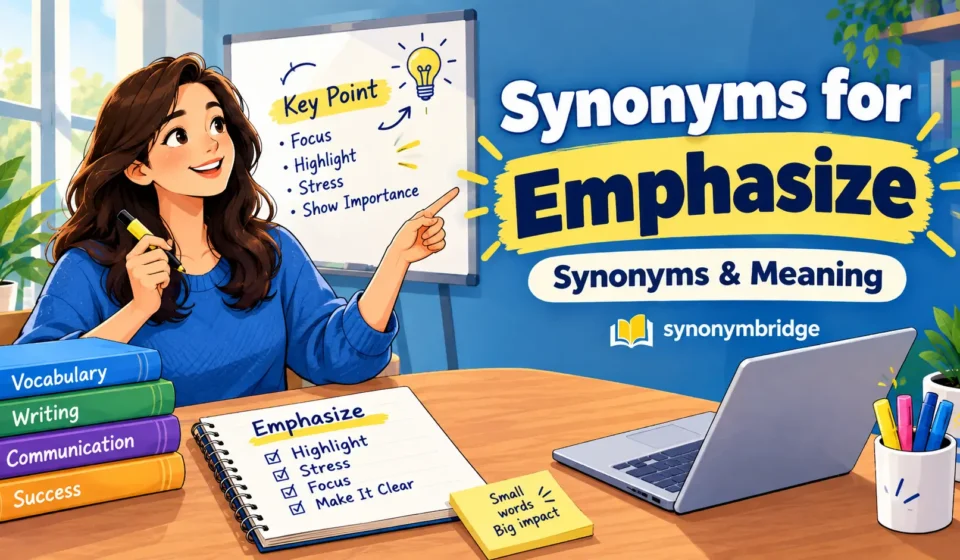
Synonyms for emphasize include stress, highlight, underline, accentuate, reinforce, underscore, point out, focus on, and draw attention to. These words help you show that an idea, fact, detail, or message is especially important in writing, speaking, essays, reports, presentations, and everyday communication.
A teacher is explaining a lesson when she pauses and says, “This point is very important.” She may repeat it, write it on the board, or give a strong example. That small change tells students where they should pay attention.
For example, a manager might emphasize teamwork during a meeting because everyone needs to work together.
Students: Synonyms help you make important ideas stand out in essays.
“Clear writing helps readers know what matters most.”
Bloggers: Different words help you avoid repeating the same expression.
“Strong words can make a simple message more powerful.”
Content writers: Precise alternatives help you create clear and professional content. Daily English users: These words make conversations, emails, and messages more natural. Learning alternatives to emphasize also helps you choose words that match your exact meaning and tone.
50 Synonyms for Emphasize
1. Stress
- Meaning: Stress means to say that something is especially important or needs attention.
- Examples: She stressed the need for practice.
The teacher stressed this point again.
2. Highlight
- Meaning: Highlight means to give special attention to an important fact or idea.
- Examples: The report highlights major problems.
She highlighted the most useful details.
3. Underline
- Meaning: Underline means to make an idea seem especially important or noticeable.
- Examples: His speech underlined the main issue.
The article underlines the need.
4. Underscore
- Meaning: Underscore means to show clearly that something has special importance.
- Examples: These results underscore the problem.
Her words underscored the main concern.
5. Accentuate
- Meaning: Accentuate means to make a feature or idea more noticeable.
- Examples: The design accentuates natural beauty.
Her speech accentuated key benefits.
6. Reinforce
- Meaning: Reinforce means to make an idea stronger or more convincing.
- Examples: Examples reinforce the main lesson.
The facts reinforced his argument.
7. Stress the importance
- Meaning: This phrase means to clearly show that something deserves special attention.
- Examples: She stressed the importance of honesty.
He stressed the importance of preparation.
8. Point out
- Meaning: Point out means to direct someone’s attention toward something important.
- Examples: She pointed out the key difference.
He pointed out several useful facts.
9. Focus on
- Meaning: Focus on means to give most attention to one particular thing.
- Examples: We focused on customer needs.
The lesson focuses on grammar.
10. Draw attention to
- Meaning: This phrase means to make people notice something important.
- Examples: The chart draws attention to costs.
Her example draws attention to safety.
11. Call attention to
- Meaning: Call attention to means to make people notice or consider something.
- Examples: The report calls attention to waste.
She called attention to the mistake.
12. Bring attention to
- Meaning: Bring attention to means to make an important point noticeable.
- Examples: The article brings attention to pollution.
He brought attention to unfair rules.
13. Give emphasis to
- Meaning: Give emphasis to means to treat something as especially important.
- Examples: The course gives emphasis to reading.
She gave emphasis to teamwork.
14. Accentuate
- Meaning: Accentuate means to make a quality, detail, or idea stand out.
- Examples: Bright colors accentuate the design.
His words accentuated the difference.
15. Amplify
- Meaning: Amplify means to make a message, feeling, or effect stronger.
- Examples: Her story amplified the message.
The image amplified its impact.
16. Magnify
- Meaning: Magnify means to make something seem more important or noticeable.
- Examples: The photo magnified small details.
Fear can magnify minor problems.
17. Intensify
- Meaning: Intensify means to make something stronger or more powerful.
- Examples: The speech intensified public interest.
Her words intensified the discussion.
18. Elevate
- Meaning: Elevate means to raise something to a more important position.
- Examples: The campaign elevated public awareness.
Her work elevated the topic.
19. Promote
- Meaning: Promote means to support or encourage an idea, cause, or activity.
- Examples: The school promotes healthy habits.
They promote equal opportunities.
20. Advocate
- Meaning: Advocate means to publicly support an idea, plan, or cause.
- Examples: She advocates better education.
He advocates careful planning.
21. Express
- Meaning: Express means to clearly communicate a thought, feeling, or idea.
- Examples: She expressed strong support.
He expressed concern about safety.
22. Declare
- Meaning: Declare means to state something clearly and firmly.
- Examples: He declared his support publicly.
She declared the plan successful.
23. Assert
- Meaning: Assert means to state something strongly and confidently.
- Examples: She asserted her main point.
He asserted that change mattered.
24. Insist on
- Meaning: Insist on means to strongly say that something must happen or matter.
- Examples: She insisted on careful work.
He insisted on following rules.
25. Reiterate
- Meaning: Reiterate means to say something again to make it clear.
- Examples: She reiterated the main message.
He reiterated his earlier warning.
“When you emphasize an idea, you help your reader see its value.”
26. Repeat
- Meaning: Repeat means to say or present something again for greater attention.
- Examples: Please repeat the important point.
She repeated the safety instructions.
27. Reaffirm
- Meaning: Reaffirm means to state support or belief in something again.
- Examples: He reaffirmed his commitment today.
She reaffirmed the team’s goals.
28. Specify
- Meaning: Specify means to state something clearly and exactly.
- Examples: Please specify your main reason.
The guide specifies each requirement.
29. Stress upon
- Meaning: Stress upon means to give special importance to a particular idea.
- Examples: Teachers stress upon regular practice.
Leaders stress upon shared goals.
30. Feature
- Meaning: Feature means to give something a noticeable or important place.
- Examples: The article features local artists.
The website features helpful examples.
31. Showcase
- Meaning: Showcase means to present something in a way that attracts attention.
- Examples: The event showcases young talent.
Her portfolio showcases strong skills.
32. Spotlight
- Meaning: Spotlight means to give special public attention to something.
- Examples: The report spotlights major concerns.
The campaign spotlights local needs.
33. Center on
- Meaning: Center on means to make one topic the main focus.
- Examples: The story centers on friendship.
The lesson centers on writing.
34. Concentrate on
- Meaning: Concentrate on means to give careful attention to one thing.
- Examples: Students concentrated on the task.
The report concentrates on results.
35. Give priority to
- Meaning: Give priority to means to treat something as more important than others.
- Examples: We give priority to safety.
The school gives priority to learning.
36. Give prominence to
- Meaning: Give prominence to means to make something especially noticeable or important.
- Examples: The article gives prominence to education.
The design gives prominence to quality.
37. Bring out
- Meaning: Bring out means to make an important quality or point more noticeable.
- Examples: Good lighting brings out details.
Her example brings out the difference.
38. Make clear
- Meaning: Make clear means to explain or show something so people understand it.
- Examples: The teacher made the point clear.
His actions made priorities clear.
39. Make prominent
- Meaning: Make prominent means to make something easy to notice or especially important.
- Examples: The design makes safety prominent.
Headlines make key facts prominent.
40. Emphasize strongly
- Meaning: Emphasize strongly means to give an idea very powerful or special attention.
- Examples: She emphasized the need strongly.
He emphasized strongly that preparation matters.
41. Draw focus to
- Meaning: Draw focus to means to direct attention toward a particular idea or detail.
- Examples: The chart draws focus to costs.
Her speech drew focus to fairness.
42. Stress out
- Meaning: Stress out is informal wording for giving too much attention or pressure.
- Examples: Don’t stress out over mistakes.
She stressed out about deadlines.
43. Impress upon
- Meaning: Impress upon means to make someone understand something as especially important.
- Examples: Teachers impress upon students the value.
She impressed upon him its importance.
44. Drive home
- Meaning: Drive home means to make an idea very clear and memorable.
- Examples: The example drove home the lesson.
Her story drove home the point.
45. Hammer home
- Meaning: Hammer home means to repeat an idea strongly so people remember it.
- Examples: The speaker hammered home the warning.
Ads hammer home their message.
46. Call out
- Meaning: Call out means to openly draw attention to something specific.
- Examples: She called out the main issue.
He called out the missing detail.
47. Emphasise
- Meaning: Emphasise is the British spelling of emphasize and has the same meaning.
- Examples: The teacher emphasised careful reading.
Her report emphasised key findings.
48. Accentuate strongly
- Meaning: Accentuate strongly means to make a feature or point stand out clearly.
- Examples: The colors accentuate the design strongly.
Her words accentuate the contrast strongly.
49. Give weight to
- Meaning: Give weight to means to treat an idea or fact as important.
- Examples: The report gives weight to evidence.
Judges give weight to facts.
50. Attach importance to
- Meaning: Attach importance to means to consider something valuable, meaningful, or important.
- Examples: She attaches importance to honesty.
They attach importance to teamwork.
Synonyms for emphasize in English
Common synonyms for emphasize in English include stress, highlight, underline, underscore, reinforce, accentuate, and focus on. These choices work in different settings.
“Highlight” is common in everyday writing, while “underscore” and “accentuate” can sound more formal. Choose a synonym based on if you are stressing an idea, fact, feeling, skill, or result.
Synonyms for emphasize in an essay
Useful synonyms for emphasize in an essay include highlight, stress, underscore, reinforce, point out, illustrate, and draw attention to. For academic writing, “underscore” can work well when discussing an important finding.
“Highlight” is simple and clear. “Reinforce” is useful when evidence makes an argument stronger.
Synonyms for emphasize and highlight
Emphasize and highlight have similar meanings, but their use can differ slightly. Alternatives include stress, underline, underscore, accentuate, reinforce, spotlight, showcase, and draw attention to.
“Spotlight” often suggests public attention, while “reinforce” means making an idea stronger. In simple writing, highlight and stress are usually easy choices.
Strong synonyms for emphasize
Strong alternatives include underscore, accentuate, reinforce, intensify, amplify, spotlight, stress, and hammer home. These words can add force to your writing. Underscore works well in formal writing.
Amplify suggests making an effect stronger. Hammer home is more informal and suggests repeating an idea until it becomes very clear.
Academic synonyms for emphasize
Academic alternatives to emphasize include underscore, highlight, reinforce, establish, stress, accentuate, and draw attention to. “Underscore” is useful when discussing the importance of research findings.
“Reinforce” works when evidence supports an argument. “Highlight” is simple and suitable for many academic sentences. The best choice depends on the exact claim.
People Also Ask
What words can I use instead of emphasis?
Instead of emphasis, you can use importance, stress, focus, attention, prominence, priority, weight, or accent. The best choice depends on the sentence. “Importance” works when discussing value, while “focus” describes where attention is placed.
“Prominence” suggests something receives special notice. For simple English, importance and focus are often the clearest alternatives.
What is another word for “strongly emphasize”?
Another way to say strongly emphasize is stress, strongly underscore, reinforce, highlight, accentuate, spotlight, drive home, or hammer home. “Drive home” means to make a message very clear and memorable.
“Hammer home” is more informal and suggests strong repetition. In formal writing, strongly underscore or reinforce may fit better.
What is another way to say “emphasizes” in an essay?
In an essay, you can replace emphasizes with highlights, stresses, underscores, reinforces, illustrates, points out, draws attention to, or shows the importance of. “Highlights” is simple and natural. “Underscores” sounds more formal. “Reinforces” works when evidence or an example makes an argument stronger. Always choose the word that matches the relationship between your evidence and main point.
What’s another word for highlight or emphasize?
Useful alternatives for highlight or emphasize include stress, underline, underscore, accentuate, reinforce, spotlight, showcase, and focus on. For everyday writing, stress and focus on are easy choices.
For formal writing, underscore can sound polished. If you are giving public attention to a person, topic, or issue, spotlight may be a better fit.
Conclusion
Learning synonyms for emphasize gives you more ways to show that an idea, fact, feeling, or message matters. Instead of using emphasize in every sentence, you can choose words such as highlight, stress, underscore, reinforce, accentuate, or spotlight.
Each word has its own small difference, so the right choice can make your message more exact.
These alternatives are useful for many kinds of communication. Students can use them to make essays clearer. Bloggers can create smoother articles without repeating the same words.
Content writers can choose vocabulary that fits formal, professional, or friendly content. Daily English users can also use these words in emails, conversations, presentations, and messages.
“A varied vocabulary gives your ideas room to shine.”
The best way to learn these words is through practice. Write a few sentences with highlight, stress, and reinforce. Then try more advanced choices such as underscore, accentuate, and reiterate. Notice how the meaning changes slightly with each word.
“Practice helps new words become natural parts of your language.”
You do not need to use difficult words just to sound smart. Good writing is about choosing a word that fits your meaning. Keep practicing these synonyms in essays, emails, blog posts, reports, presentations, and daily conversations.
With time, your vocabulary will become richer, your writing will become more flexible, and your ideas will become easier for readers to understand.