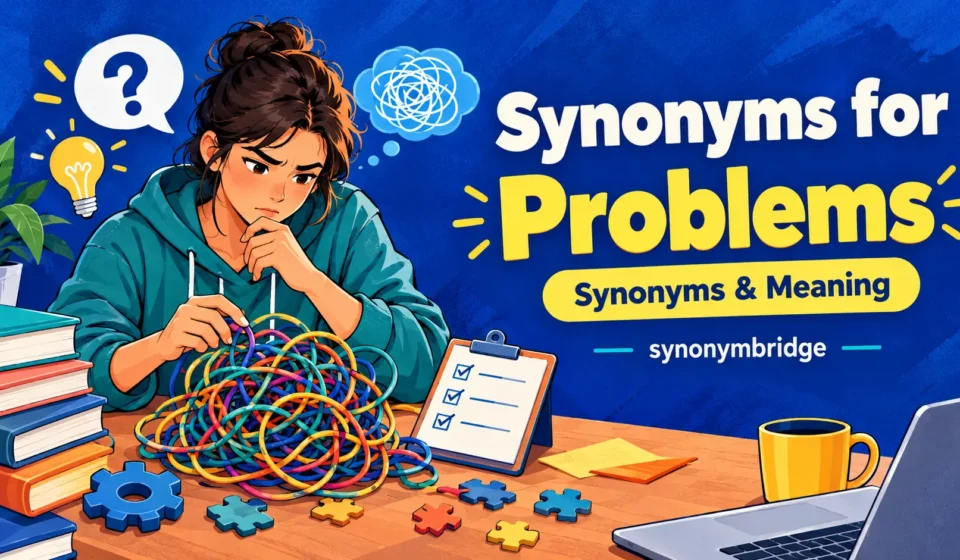
Synonyms for problems include issues, challenges, difficulties, troubles, obstacles, concerns, and complications. Each word has a slightly different meaning, so the best choice depends on your situation. Use simple words in daily talks, formal words in work emails, and strong words when describing serious difficulties.
Imagine you are working on a school project, but your computer stops working. You try to fix it, yet nothing seems to help. Later, your friend gives you a useful idea, and you finish the project on time. Choosing the right words helps you explain such moments clearly.
For example, you might tell your teacher about a problem with your homework. You could also describe it as a difficulty or challenge. Each word gives your message a slightly different feel.
Students can use these words to make essays clearer. Bloggers can use them to keep readers interested. Content writers can avoid repeating the same word in every paragraph. Daily English users can express their thoughts with more confidence.
“The right words make hard things easier to explain.”
Learning new words also helps you understand what other people mean. Some words sound gentle, while others show that a situation is serious. Knowing these differences helps you choose words that fit your message.
“Clear words help people understand each other.”
These words can help you describe small concerns, serious issues, and difficult situations. Choose the word that best matches your meaning and tone.
1. Issue
Meaning: An issue is something that needs attention, thought, or action.
Examples:
- We discussed the issue after class.
- Please report any issue with your order.
2. Challenge
Meaning: A challenge is a hard task that needs effort to complete.
Examples:
- Learning English can be a fun challenge.
- She faced a challenge at work yesterday.
3. Difficulty
Meaning: A difficulty is something that makes an action harder to do.
Examples:
- He had difficulty opening the heavy door.
- We faced difficulty during the long trip.
4. Trouble
Meaning: Trouble describes a situation that causes worry, harm, or extra work.
Examples:
- My phone is giving me trouble today.
- She got into trouble for arriving late.
5. Obstacle
Meaning: An obstacle is something that blocks progress toward a goal.
Examples:
- Lack of time became an obstacle.
- We removed every obstacle from our path.
6. Concern
Meaning: A concern is something that makes someone feel worried or uneasy.
Examples:
- Money is a concern for our family.
- The teacher shared her concern with parents.
7. Complication
Meaning: A complication is something that makes a situation harder to manage.
Examples:
- Rain caused a complication during the event.
- We solved the complication before lunch.
8. Setback
Meaning: A setback is a problem that delays progress or success.
Examples:
- The broken laptop was a major setback.
- She recovered quickly after the setback.
9. Hurdle
Meaning: A hurdle is a difficulty you must overcome to succeed.
Examples:
- Finding a job was her first hurdle.
- We cleared each hurdle as a team.
10. Barrier
Meaning: A barrier is something that prevents people from moving forward.
Examples:
- Fear became a barrier to his success.
- We removed the barrier near the entrance.
11. Issue of Concern
Meaning: An issue of concern is something that needs careful attention.
Examples:
- Staff safety remains an issue of concern.
- The delay became a concern.
12. Difficulty
Meaning: Difficulty describes a condition in which something is not easy to do.
Examples:
- She had difficulty understanding the new rules.
- We faced difficulty finding the right address.
13. Predicament
Meaning: A predicament is a difficult situation with no easy way out.
Examples:
- He found himself in a serious predicament.
- We helped her escape that difficult predicament.
14. Dilemma
Meaning: A dilemma is a hard choice between two possible actions.
Examples:
- She faced a dilemma about whether to change schools.
- His dilemma kept him awake all night.
15. Crisis
Meaning: A crisis is a serious situation that needs quick action.
Examples:
- The town faced a water crisis.
- Leaders met to manage the growing crisis.
16. Emergency
Meaning: An emergency is a dangerous situation that needs immediate help.
Examples:
- Call for help during a medical emergency.
- The team acted quickly in the emergency.
17. Conflict
Meaning: A conflict is a serious disagreement between people or groups.
Examples:
- The conflict started over a small mistake.
- They worked together to end the conflict.
18. Dispute
Meaning: A dispute is an argument about something people disagree on.
Examples:
- The neighbors had a dispute over parking.
- Both sides agreed to settle the dispute.
19. Fault
Meaning: A fault is a mistake or defect that causes trouble.
Examples:
- The machine stopped because of an electrical fault.
- We found a fault in the report.
20. Error
Meaning: An error is something incorrect that may cause an unwanted result.
Examples:
- I made an error in my answer.
- The error changed the final score.
21. Mistake
Meaning: A mistake is an action or choice that is not correct.
Examples:
- Everyone makes a mistake from time to time.
- He fixed his mistake before submitting the form.
22. Defect
Meaning: A defect is a fault that makes something less useful or safe.
Examples:
- The shop replaced the phone with a defective one.
- Inspect the product for any visible defects.
23. Flaw
Meaning: A flaw is a weakness or fault in something.
Examples:
- The plan had one serious flaw.
- She noticed a flaw in his argument.
24. Weakness
Meaning: A weakness is something that limits strength, ability, or success.
Examples:
- Poor planning was the team’s main weakness.
- We worked together to fix this weakness.
25. Shortcoming
Meaning: A shortcoming is a fault that prevents someone or something from being better.
Examples:
- The report had one clear shortcoming.
- He accepted his shortcoming and improved his work.
26. Limitation
Meaning: A limitation is something that restricts what someone or something can do.
Examples:
- Time was our biggest limitation today.
- Every plan has a limitation to consider.
27. Drawback
Meaning: A drawback is a negative feature that makes something less useful.
Examples:
- The high price is one major drawback.
- Every choice has a drawback to consider.
28. Risk
Meaning: A risk is the chance that something harmful may happen.
Examples:
- Driving too fast increases the risk of accidents.
- We discussed the risk before making changes.
29. Threat
Meaning: A threat is something that may cause harm or danger.
Examples:
- Smoke posed a threat to nearby homes.
- The storm became a threat to farmers.
30. Danger
Meaning: Danger is the chance of harm, injury, or loss.
Examples:
- The wet floor created a danger for visitors.
- They moved away from the danger quickly.
31. Complication
Meaning: A complication makes a task or situation harder than expected.
Examples:
- A late delivery caused a complication today.
- We handled the complication with care.
32. Burden
Meaning: A burden is a heavy duty or worry that is hard to carry.
Examples:
- Extra bills became a burden for them.
- She shared her burden with a trusted friend.
33. Struggle
Meaning: A struggle is a hard effort to deal with something difficult.
Examples:
- Paying rent became a daily struggle.
- He faced a struggle while learning to read.
34. Hardship
Meaning: A hardship is a difficult experience that causes pain or trouble.
Examples:
- The family faced hardship after the flood.
- They stayed hopeful through every hardship.
35. Adversity
Meaning: Adversity means facing hard events that test your strength and patience.
Examples:
- She showed courage in the face of adversity.
- Friends helped him overcome personal adversity.
36. Distress
Meaning: Distress is great worry, sadness, or pain caused by trouble.
Examples:
- The news caused distress among local families.
- He called for help in his distress.
37. Disruption
Meaning: A disruption is something that interrupts a normal activity or process.
Examples:
- Heavy rain caused a disruption in travel.
- We worked around the disruption at school.
38. Delay
Meaning: A delay happens when something takes longer than expected to happen.
Examples:
- The train delay upset many passengers.
- We faced a delay because roads were closed.
39. Obstruction
Meaning: An obstruction is something that blocks a path or prevents action.
Examples:
- A fallen tree caused an obstruction.
- Workers cleared the obstruction from the road.
40. Barrier to Progress
Meaning: A barrier to progress is something that stops improvement or growth.
Examples:
- Poor planning became a barrier to progress.
- We removed this barrier to progress together.
41. Complication in a Plan
Meaning: A complication in a plan is an unexpected issue that changes the steps.
Examples:
- Bad weather caused a complication in our plan.
- We changed the plan after the complication.
42. Concern
Meaning: A concern is a matter that people believe needs care or action.
Examples:
- Clean water is a concern for residents.
- The manager listened to every staff concern.
43. Grievance
Meaning: A grievance is a complaint about unfair treatment or a wrong action.
Examples:
- She filed a grievance about unfair pay.
- The manager reviewed his grievance with care.
44. Complaint
Meaning: A complaint is a statement that something is wrong or unsatisfactory.
Examples:
- The customer made a complaint about delivery.
- We answered every complaint with respect.
45. Disagreement
Meaning: A disagreement happens when people have different views or opinions.
Examples:
- Their disagreement began during the team meeting.
- We settled the disagreement through calm discussion.
46. Tension
Meaning: Tension is a feeling of stress caused by worry or conflict.
Examples:
- Tension grew before the final match.
- A friendly talk helped reduce the tension.
47. Misunderstanding
Meaning: A misunderstanding happens when someone gets the wrong idea about something.
Examples:
- A short message caused a misunderstanding.
- They cleared up the misunderstanding after lunch.
48. Mess
Meaning: A mess is a confused or untidy situation that needs fixing.
Examples:
- We made a mess while painting the room.
- She helped clean up the whole mess.
49. Trouble Spot
Meaning: A trouble spot is a place or area where difficulties often happen.
Examples:
- The old bridge is a trouble spot.
- Police checked the trouble spot after dark.
50. Predicament
Meaning: A predicament is a tough position that makes choosing the next step difficult.
Examples:
- Losing his keys left him in a predicament.
- We found a way out of the predicament.
Note: Some words above have similar meanings, but they are not always interchangeable. For example, crisis suggests serious danger, while concern may describe something that only needs attention. Choose words based on the level of difficulty and the context.
Synonyms for Problems or Issues
The words issues, concerns, difficulties, and complications can replace “problems” in many sentences. Use issues for general matters that need attention, concerns when people feel worried, and complications when something makes a situation harder.
For example, “We discussed the issues during the meeting” sounds natural in everyday and workplace English. Choose the word that best explains what is happening.
Synonyms for Problems Solving
When talking about problem solving, useful related words include troubleshooting, resolving issues, finding answers, and overcoming challenges. Problem solving describes the process of finding a way to fix something.
For example, “Our team used troubleshooting to fix the computer.” In school, work, or daily life, this phrase highlights action rather than the difficulty itself. Use it when describing skills, methods, or steps taken to reach a solution.
Synonyms for Problems in Life
Life can bring hardships, struggles, setbacks, and challenges. These words describe difficult experiences, but each has a different tone. A setback slows your progress, while a hardship may cause lasting pain or stress.
For example, “She faced many challenges but kept moving forward.” These alternatives help you write about personal growth, family concerns, money worries, and other life experiences without repeating the same word.
Formal Synonyms for Problems
In formal writing, consider issues, concerns, difficulties, complications, and obstacles. These words suit reports, essays, business emails, and academic discussions. For example, “The study identifies several issues affecting student progress” sounds more precise than “The study talks about problems.”
Use concerns when highlighting matters that need attention and obstacles when explaining what prevents progress. Match your choice to the facts and avoid using a serious word for a minor issue.
Synonyms for Problems in Society
Social problems can also be called social issues, public concerns, challenges, or societal difficulties. These phrases help explain matters that affect communities, such as poverty, poor access to education, and pollution. For example, “Pollution remains a major social issue in many cities.”
Use public concerns when discussing what worries people and societal challenges when describing wider barriers to change. Clear wording helps readers understand both the issue and its effect on society.
“Every challenge becomes easier when you break it into smaller steps.”
Frequently Asked Questions
1. What is a better word than “problems”?
A better word depends on what you want to express. Use issues for general matters, challenges for tasks that need effort, and concerns for things that cause worry.
In professional writing, complications can describe situations that become harder to manage. For example, “We need to address these issues” sounds clear in a work email. Choose the word that fits your message and audience.
2. What are big synonyms for problem?
Strong synonyms for a problem include crisis, catastrophe, dilemma, predicament, and major obstacle. A crisis is a serious situation that needs quick action, while a catastrophe describes an event that causes great damage or suffering.
A dilemma involves a difficult choice. For example, “The flood created a major crisis for the town.” Use these stronger words when the situation is serious, not for small everyday concerns.
3. What is a better word for trouble?
You can replace trouble with difficulty, hardship, distress, complication, or concern, depending on the situation. Use difficulty for something that is hard to do, hardship for a painful experience, and distress for deep worry or sadness.
For example, “The family faced financial hardship last winter” gives a clearer picture than “The family had trouble.” In casual conversation, trouble is still a natural and useful choice.
4. What is a better word for problem statement?
A better term for problem statement depends on the type of writing. In research, research problem or statement of the issue may fit. In business, business challenge or issue description can work when the context supports it.
A problem statement explains what needs to be addressed and why it matters. For example, “This research examines the lack of clean drinking water in rural areas.” Choose a term that keeps your purpose clear.
Conclusion
Learning synonyms for problems helps you express ideas in a clear and natural way. Instead of repeating the same word, you can choose issues, challenges, concerns, obstacles, or difficulties to explain different situations. Each word adds a slightly different meaning to your message.
Students can use these words to write better essays and give clearer answers. Bloggers and content writers can make their articles easier to read by choosing words that fit each topic. In daily conversations, the right word helps you explain what happened and what kind of help you need.
Start by learning five new words from this list. Write a short sentence for each one, then use them in an email, an essay, or a conversation. Remember that a strong word is not always the best word. A simple, accurate choice often communicates your message more effectively than a fancy one.
“Small steps can lead to meaningful progress.”
Keep practicing, and pay attention to how people use these words in real life. Over time, you will become more confident in your writing and speaking. The goal is not to use the most complicated word. It is to choose the word that says exactly what you mean.
“Good communication begins with clear and thoughtful words.”