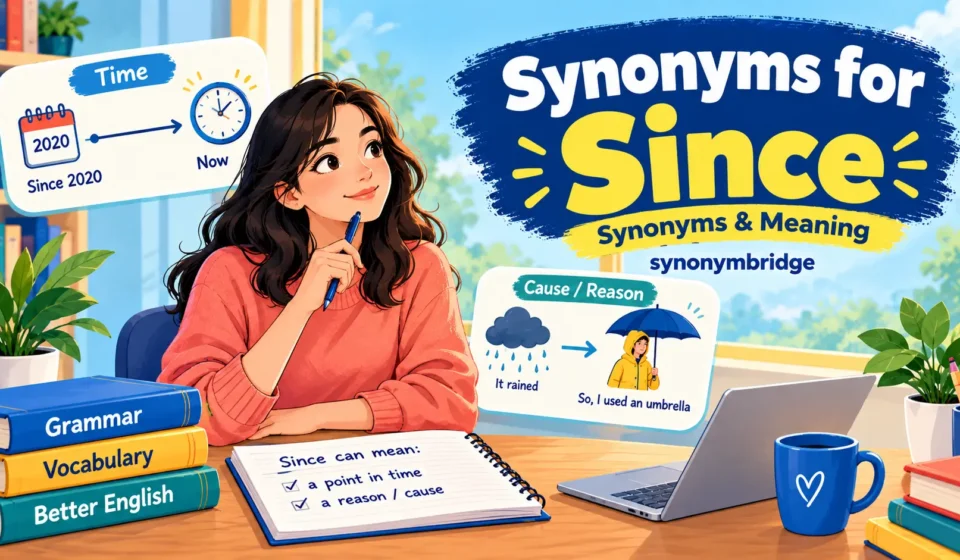
A good synonym for since is because when you give a reason, and ever since or from then on when you talk about time. For example, “since it rained” becomes “because it rained,” and “since Monday” becomes “from Monday onward.” Pick the word that fits your sentence.
Maya read her essay out loud and stopped. The word “since” showed up four times in one paragraph. It sounded flat, and it was also confusing. Did she mean “because” or “from that time”? Sound familiar? Many writers face this small problem every day.
“The difference between the almost right word and the right word is really a large matter.” Mark Twain
Here is a simple case. “Since the shop closed, I walked home” could mean two things. Maybe I walked home because it closed, or maybe I walked home after that time. A clearer word fixes the doubt at once.
Students write cleaner essays. Bloggers keep readers interested. Content writers avoid repeating the same word. Daily English users sound clear and confident in chats and emails. Each word here is easy to learn, so read on for 50 simple choices with easy examples.
“Language is the road map of a culture.” Rita Mae Brown
Since does two jobs in English. It gives a reason, or it marks time. Entries 1 25 below fit reasons. Entries 26 50 fit time.
“Words are, of course, the most powerful drug used by people.” Rudyard Kipling
1. Because
- Meaning: Tells the reason why something happens or why it is true.
- Examples: I stayed home because it was raining hard. / She smiled because the test went so well.
2. As
- Meaning: Gives a reason, and it often comes at the start.
- Examples: As it was late, we went home. / As you are tired, please rest today.
3. Given That
- Meaning: Points to a known fact that explains the next idea.
- Examples: Given that he is new, please help him. / Given that prices rose, we bought less food.
4. Seeing That
- Meaning: Introduces a clear fact that leads to a choice or decision.
- Examples: Seeing that you are busy, I will wait. / Seeing that it snowed, school closed early.
5. Considering That
- Meaning: Asks the reader to think about one fact before judging.
- Examples: Considering that she practiced daily, her win makes sense. / He did well, considering that he was sick.
6. Now That
- Meaning: Means because something has changed and the new fact matters.
- Examples: Now that I’m older, I read more books. / Now that school has ended, we can travel.
7. Inasmuch As
- Meaning: A formal phrase that gives a reason, often in writing.
- Examples: The plan works, inasmuch as it saves money. / Inasmuch as you asked, here is my answer.
8. Owing to the Fact That
- Meaning: A formal way to explain the cause of an event.
- Examples: Owing to the fact that it flooded, we waited. / Owing to the fact that he left, I stayed.
9. Due to the Fact That
- Meaning: A wordy but common phrase that names the cause.
- Examples: We closed due to the fact that power failed. / Due to the fact that I slept, I’m fresh.
10. In View of the Fact That
- Meaning: A formal phrase that uses a fact to support a decision.
- Examples: In view of the fact that it’s late, rest. / In view of the fact that you won, celebrate.
11. For
- Meaning: A short, old style word that gives a reason in formal writing.
- Examples: She wept, for her friend was gone. / He rested, for the road was long.
12. Seeing As
- Meaning: A casual phrase that gives the reason for what follows.
- Examples: Seeing as you’re here, please sit down. / Seeing as it’s cold, wear a coat.
13. Seeing How
- Meaning: A casual phrase that links a reason to your action.
- Examples: Seeing how you love pizza, let’s order some. / Seeing how tired I am, I’ll sleep early.
14. Being That
- Meaning: A spoken phrase that means because, used in relaxed talk.
- Examples: Being that it’s Friday, we can relax tonight. / Being that you cooked, I will wash up.
15. On the Grounds That
- Meaning: Gives the main reason or basis for an action.
- Examples: He refused on the grounds that it’s unsafe. / She stayed on the grounds that rain was coming.
16. In Light of the Fact That
- Meaning: A formal phrase that uses new facts to explain a choice.
- Examples: In light of the fact that you helped, thanks. / In light of the fact that it’s late, sleep.
17. For the Reason That
- Meaning: A clear phrase that states the exact cause of something.
- Examples: I walked for the reason that buses were late. / He laughed for the reason that it was funny.
18. Forasmuch As
- Meaning: An old, very formal phrase that means because or since.
- Examples: Forasmuch as you came, you may stay. / Forasmuch as he paid, the seat is his.
19. In That
- Meaning: A short formal phrase that explains how something is true.
- Examples: The tool helps, in that it saves time. / She is lucky in that she has good friends.
20. Whereas
- Meaning: Used in formal papers to give a reason or show contrast.
- Examples: Whereas the rules changed, we updated the form. / Whereas he is kind, I’ll trust him.
21. On Account Of
- Meaning: A common phrase that links a result to its cause.
- Examples: We stayed in on account of the storm. / The game ended early on account of rain.
22. By Reason Of
- Meaning: A formal phrase that means because of a certain thing.
- Examples: He left early by reason of illness. / Prices rose by reason of a short supply.
23. Thanks to the Fact That
- Meaning: A friendly phrase that gives a good reason for success.
- Examples: Thanks to the fact that you called, I woke. / Thanks to the fact that she studied, she passed.
24. Granted That
- Meaning: Accepts one fact as true before giving the next idea.
- Examples: Granted that he’s young, he works hard. / Granted that it’s costly, it is worth it.
25. Given
- Meaning: A short word that bases an idea on a known fact.
- Examples: Given his skill, he should join the team. / Given the heat, we swam all afternoon.
26. Ever Since
- Meaning: Means from a past time up to the present moment.
- Examples: Ever since I moved, I sleep better. / She has smiled ever since she met him.
27. From Then On
- Meaning: Means starting at that moment and continuing for all later time.
- Examples: From then on, we walked to school together. / He ran every morning from then on.
28. Since Then
- Meaning: Means any time after a certain event up to now.
- Examples: I got a puppy; since then, life is fun. / She quit soda and has felt great since then.
29. Thereafter
- Meaning: A formal word that means after that time or after that event.
- Examples: He graduated and thereafter moved to Lahore. / Thereafter, the shop opened every day at nine.
30. Subsequently
- Meaning: Means at a later time, after something else has happened.
- Examples: She applied and subsequently got the job. / We missed the bus and subsequently walked home.
31. Afterward
- Meaning: Means at a later time, following something that just happened.
- Examples: We ate dinner and watched a movie afterward. / Afterward, she felt calm and very happy.
32. From That Time
- Meaning: Means beginning at a moment already named in a story.
- Examples: From that time, they were best friends. / He saved a little money from that time.
33. From That Day Forward
- Meaning: A warm phrase for a new habit that begins on one day.
- Examples: From that day forward, she sang every morning. / I promised to be kind from that day forward.
34. Henceforth
- Meaning: A formal word that means from this moment into the future.
- Examples: Henceforth, all students must wear a name tag. / Henceforth, I will check my spelling twice.
35. Thenceforth
- Meaning: An old, formal word that means from that time onward.
- Examples: Thenceforth, the king ruled with great care. / He thenceforth lived quietly in the hills.
36. Hereafter
- Meaning: A formal word that means from now on in the future.
- Examples: Hereafter, please send your forms before Friday noon. / The terms are listed hereafter in this guide.
37. After
- Meaning: A simple word that points to a time following something.
- Examples: After the move, she made many friends. / He has felt fine after that doctor visit.
38. Starting From
- Meaning: Names the first point in time when something begins to count.
- Examples: Starting from Monday, we open at eight. / Starting from today, I will drink more water.
39. Beginning From
- Meaning: Marks the exact point when a time period or plan begins.
- Examples: Beginning from June, the library closes earlier. / Beginning from age five, he played the violin.
40. Ever After
- Meaning: Used in stories to mean for all the time that followed.
- Examples: They lived happily ever after in a small town. / She was kind to animals ever after.
41. Since That Moment
- Meaning: Points to one clear moment and every day that followed.
- Examples: Since that moment, I never skipped breakfast again. / He has trusted her since that moment.
42. Following That
- Meaning: Means right after something has happened and often because of it.
- Examples: Following that, we drove straight to the beach. / Following that talk, he changed his plans.
43. From That Point On
- Meaning: Marks a turning point after which things stay quite different.
- Examples: From that point on, he studied every night. / From that point on, the team never lost.
44. Up Until Now
- Meaning: Covers the whole time before today, from a past start.
- Examples: Up until now, I have never tried sushi. / She has worked here up until now.
45. All This Time
- Meaning: Means the whole period from a past point until the present.
- Examples: I have waited here all this time. / All this time, he kept the secret.
46. To This Day
- Meaning: Shows that something that began long ago still goes on.
- Examples: To this day, we still bake her recipe. / He remembers the trip to this day.
47. From the Start
- Meaning: Means from the very first moment that a thing began to happen.
- Examples: I felt happy with the team from the start. / From the start, the plan seemed too risky.
48. Onward
- Meaning: Means moving forward in time from a point already given.
- Examples: From noon onward, the shop stays very busy. / She wrote in her journal from May onward.
49. In the Time Since
- Meaning: Describes what changed during the period after a past event.
- Examples: In the time since, our town has grown. / How much have you learned in the time since?
50. Later On
- Meaning: Means at some point after the time you are talking about.
- Examples: He felt sad, but later on he laughed. / We will talk about it later on.
Synonyms for Since Then
When you tell a story, since then shows what happened after one key event. You can swap it for after that, from that day on, later, or ever since. Try: “She lost her keys in May. From that day on, she kept them in a bowl.”
Each choice moves your story forward and keeps the sentences fresh, so readers never feel bored.
Synonyms for Since the Beginning
Since the beginning points to the very first moment of something. Good swaps include from the start, from day one, from the outset, and from the very first. For example, “The team trusted her from day one.”
These phrases sound strong and personal, so they work really well in speeches, resumes, and stories about long friendships or old family habits.
Synonyms for Since in an Essay
Essays need clear logic, so choose since carefully. Use because for plain reasons, given that for known facts, and as for light links. For time, try after, from, or subsequently. Example: “Given that sea levels are rising, cities must prepare.”
Teachers and readers like this precise wording, because it shows you understand cause, effect, and timing instead of repeating one word.
Synonyms for Since Childhood
Since childhood describes something that began when you were small. You can say from a young age, ever since I was little, from my early years, or all my life. Try: “I have loved drawing from a young age.”
These phrases add warmth to bios, about pages, and personal essays, and they help readers picture the early years behind your story.
Synonyms for Since the Dawn of Time
Since the dawn of time is a dramatic way to say for as long as anyone can remember. Try since ancient times, throughout history, for countless ages, or from time immemorial. Example: “People have told stories throughout history.”
Use these grand phrases sparingly. A little drama can excite readers, but too much can sound like exaggeration, so keep your facts honest.
FAQ
What is another word for “since”?
The best word depends on meaning. For a reason, use because, as, or given that. For time, use after, from then on, or subsequently. A quick test helps: if you can replace “since” with “because,” you want a reason word.
If you can say “from that time,” you want a time word. Always read the new sentence aloud to check that it sounds natural.
What is another word for “ever since”?
Ever since means from a past moment until now. You can use from that time on, all this time, up until now, or from the day that. For example, “I have slept well ever since the move” can become “I have slept well from the day we moved.”
These swaps give longer sentences a gentler, more natural rhythm and make your writing less repetitive.
How do you say “since” in a formal way?
In formal writing, pick words that sound careful and exact. Use inasmuch as, given that, in view of the fact that, or owing to for reasons. Use subsequently, thereafter, or henceforth for time. Avoid slangy choices like “seeing as.”
Simple words like because and after also stay safe in reports, letters, and academic papers, and they are often better than long, wordy phrases.
What is another word for “because” or “since”?
Both words give reasons, but they feel a little different. Because is direct and stresses the cause. Since and as usually mention a reason the reader already knows. Say “Because it rained, the match ended” to stress the cause.
Say “Since you are here, help me” for a known reason. Since also marks time, so because is often clearer when you want zero confusion.
Conclusion
Learning synonyms is one of the easiest ways to grow as a writer. When you know many ways to say since, your sentences become clearer, smoother, and more interesting. Bloggers keep readers longer. Students earn better marks. Speakers sound calm and sure. Everyday talkers share ideas without confusion.
“The limits of my language mean the limits of my world.” Ludwig Wittgenstein
Start small. Pick five words from this list and use them this week. Add because to an email, ever since to a story, and subsequently to an essay. Notice how each word changes the feeling of the sentence. Read your work aloud, and swap words that sound repeated or heavy.
Remember the key rule: first decide if since means a reason or a time, then choose the matching word. That one step prevents most mistakes. Keep this guide close, return to it when you write, and your vocabulary will keep growing. Every new word you practice makes your voice clearer.
“A different language is a different vision of life.” Federico Fellini
Now it is your turn. Which synonym will you try first?