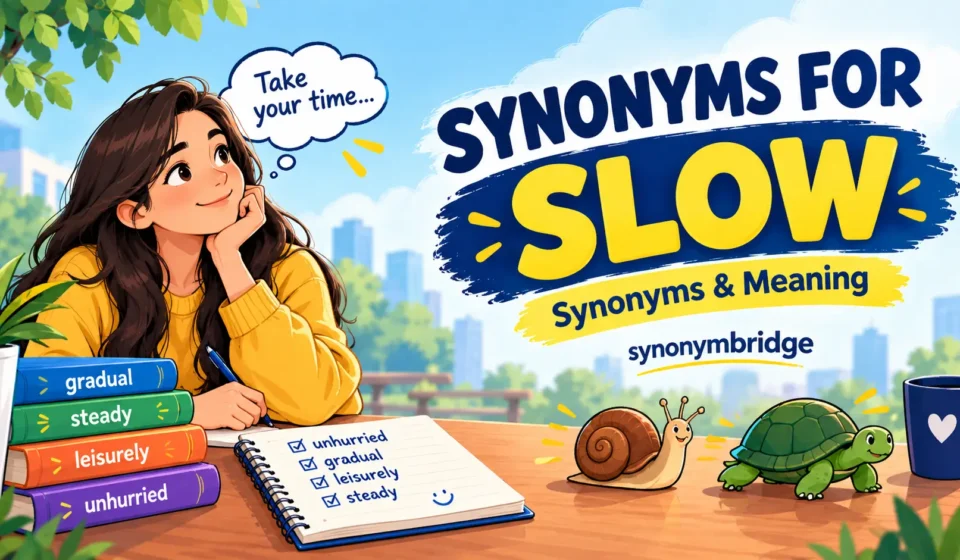
Common synonyms for slow include unhurried, gradual, sluggish, leisurely, delayed, steady, gentle, leisurely, crawling, and sluggish. The best choice depends on the situation. Some words describe low speed, while others suggest calm movement, late action, slow progress, or a relaxed pace.
The bus is almost here, but your friend is still walking toward the stop. You call out, “Hurry up!” He laughs and says, “I’m coming. I’m just taking my time.” That small moment shows why choosing the right word matters.
The word slow can describe movement, work, learning, progress, or even a relaxed day. However, using the same word again and again can make your writing sound plain. A better word can show the exact feeling or situation.
For students, these words make essays and answers more interesting. Bloggers can use them to create clearer and more natural content. Content writers can choose words that fit each sentence better. Daily English users can speak with more variety and confidence.
“The right word makes a simple idea clearer.”
Learning several alternatives also helps you understand small differences in meaning. For example, gradual sounds are different from sluggish, even though both can relate to slow action.
“Good writing is often about choosing simple words well.”
1. Unhurried
- Meaning: Moving or acting calmly without feeling any need to hurry.
- Examples: He took an unhurried walk home.
She gave an unhurried reply.
2. Gradual
- Meaning: Happening slowly over time instead of happening all at once.
- Examples: Her progress was gradual but clear.
The weather brought a gradual change.
3. Sluggish
- Meaning: Moving slowly because there is little energy or strength.
- Examples: I felt sluggish after lunch.
The old computer seems sluggish today.
4. Leisurely
- Meaning: Done slowly and comfortably without pressure or a hurry.
- Examples: We enjoyed a leisurely breakfast.
They took a leisurely afternoon walk.
5. Leisure
- Meaning: Happening at a relaxed speed with plenty of free time.
- Examples: He spent the morning at leisure.
She enjoys leisure activities on weekends.
6. Crawling
- Meaning: Moving extremely slowly, often at a frustratingly low speed.
- Examples: Traffic was crawling near downtown.
The line was crawling forward slowly.
7. Lagging
- Meaning: Falling behind others because something is moving or working slowly.
- Examples: My internet is lagging again.
The team is lagging behind today.
8. Delayed
- Meaning: Happening later than expected because something causes a hold up.
- Examples: Our flight was delayed again.
The meeting started after a delayed train.
9. Steady
- Meaning: Moving at a regular speed without sudden changes or stops.
- Examples: She made steady progress daily.
Keep a steady walking pace.
10. Gentle
- Meaning: Moving or happening softly without sudden force or speed.
- Examples: He used a gentle movement.
The boat made a gentle turn.
11. Measured
- Meaning: Done carefully and slowly with control and thoughtful timing.
- Examples: She gave a measured response.
He walked with measured steps.
12. Plodding
- Meaning: Moving slowly and heavily, often because you feel tired.
- Examples: He came home with plodding steps.
The tired horse kept plodding forward.
13. Torpid
- Meaning: Very inactive or slow because of low energy or interest.
- Examples: The hot afternoon felt torpid.
He seemed torpid after the long trip.
14. Languid
- Meaning: Moving slowly in a relaxed way without much energy.
- Examples: She made a languid gesture.
The afternoon passed in a languid mood.
15. Stagnant
- Meaning: Failing to develop, grow, or move forward for some time.
- Examples: Business growth became stagnant.
His career felt stagnant for years.
16. Static
- Meaning: Staying still without showing much movement or change.
- Examples: The picture remained static.
Progress stayed static that month.
17. Inactive
- Meaning: Not moving, working, growing, or doing something actively.
- Examples: The account has been inactive.
The machine stayed inactive all day.
18. Sleepy
- Meaning: Moving or acting slowly because you feel tired or ready to sleep.
- Examples: I feel sleepy this morning.
The sleepy dog barely moved.
19. Tardy
- Meaning: Arriving or happening later than the expected or proper time.
- Examples: He was tardy for class.
Her tardy reply caused concern.
20. Behind
- Meaning: Failing to keep up with the expected time, speed, or progress.
- Examples: We are behind schedule.
She fell behind with homework.
21. Hesitant
- Meaning: Acting slowly because you are unsure about what to do.
- Examples: He was hesitant to answer.
She took a hesitant step forward.
22. Reluctant
- Meaning: Moving or acting slowly because you do not really want to.
- Examples: He was reluctant to leave.
She gave a reluctant nod.
23. Inert
- Meaning: Having little movement, action, energy, or ability to respond.
- Examples: The object remained inert.
He looked inert after working hard.
24. Sedate
- Meaning: Calm and unhurried, with little excitement or fast movement.
- Examples: The town has a sedate feel.
They enjoyed a sedate evening together.
25. Unhurriedly
- Meaning: Doing something calmly without trying to finish it quickly.
- Examples: She walked unhurriedly home.
He spoke unhurriedly during lunch.
26. Gradually
- Meaning: Happening little by little instead of changing suddenly or quickly.
- Examples: The noise gradually disappeared.
She gradually improved her writing.
27. Slowly
- Meaning: Moving or happening at a low speed rather than quickly.
- Examples: Please drive slowly here.
The door opened slowly.
28. Cautiously
- Meaning: Moving carefully and slowly because you want to avoid danger or mistakes.
- Examples: He walked cautiously on ice.
She cautiously opened the box.
29. Deliberately
- Meaning: Doing something carefully and slowly because you have chosen that way.
- Examples: He deliberately spoke more slowly.
She deliberately checked every answer.
30. Patiently
- Meaning: Waiting or acting calmly without becoming upset by delay.
- Examples: She waited patiently outside.
He patiently explained the lesson.
31. Methodically
- Meaning: Doing something slowly and carefully by following an organized process.
- Examples: He worked methodically through the list.
She methodically checked each file.
32. Laboriously
- Meaning: Doing something slowly and with much effort because it is difficult.
- Examples: He climbed laboriously uphill.
She worked laboriously through the problem.
33. Heavily
- Meaning: Moving with effort and weight, often making movement slower.
- Examples: He breathed heavily after running.
The tired man walked heavily.
34. Tardily
- Meaning: Happening later than expected or at a slower required pace.
- Examples: The report arrived tardily.
He responded tardily to messages.
35. Poky
- Meaning: Very slow or taking too much time to finish something.
- Examples: This old car is poky.
The service here feels poky.
36. Sluggishly
- Meaning: Moving or working slowly because of weakness, tiredness, or low energy.
- Examples: The engine started sluggishly.
He walked sluggishly after lunch.
37. Unhurried
- Meaning: Calm and relaxed because there is no pressure to move quickly.
- Examples: Her style is unhurried and calm.
We had an unhurried conversation.
38. Slow moving
- Meaning: Moving at a low speed compared with what is normally expected.
- Examples: We passed a slow moving truck.
The slow moving line annoyed everyone.
39. Slow paced
- Meaning: Happening at a relaxed speed with little fast action or change.
- Examples: The movie has a slow paced story.
They prefer a slow paced lifestyle.
40. Drawn out
- Meaning: Taking much longer than expected or needed to finish.
- Examples: The meeting became drawn out.
It was a drawn out discussion.
41. Protracted
- Meaning: Continuing for a long time, especially longer than people expected.
- Examples: The talks became protracted.
They faced a protracted delay.
42. Lingering
- Meaning: Staying or continuing longer than expected instead of ending quickly.
- Examples: A lingering smell filled the room.
She had lingering doubts afterward.
43. Lagging
- Meaning: Moving more slowly than another person, system, or expected level.
- Examples: My laptop is lagging badly.
The project is lagging behind.
44. Creeping
- Meaning: Moving very slowly and carefully, often close to the ground.
- Examples: The cat came creeping closer.
Fog was creeping across the road.
45. Ambling
- Meaning: Walking slowly in a relaxed way without a clear need to hurry.
- Examples: We went ambling through town.
He came ambling down the street.
46. Sauntering
- Meaning: Walking slowly in a relaxed and confident way without rushing.
- Examples: She came sauntering into class.
He was sauntering along the beach.
47. Dawdling
- Meaning: Taking too much time because you move or act without enough purpose.
- Examples: Stop dawdling and get ready.
The child was dawdling before school.
48. Loitering
- Meaning: Staying or moving around slowly without a clear reason to leave.
- Examples: Several people were loitering outside.
He spent time loitering near shops.
49. Unenergetic
- Meaning: Showing little energy, power, or speed while doing something.
- Examples: His performance seemed unenergetic.
The team looked unenergetic today.
50. Careful
- Meaning: Moving slowly enough to avoid mistakes, danger, or unwanted problems.
- Examples: Be careful on those stairs.
She took a careful step.
“A slower pace can sometimes give you time to notice what speed makes you miss.”
Synonyms for slow down
There are many useful ways to express slow down, depending on the situation. You can say reduce speed, ease up, decelerate, take it easy, or relax your pace. For everyday speech, “take it easy” sounds friendly. In formal writing, “reduce speed” or “decelerate” may fit better.
Synonyms for slow moving
For something that moves slowly, useful alternatives include sluggish, crawling, creeping, leisurely, and unhurried. “Slow moving” is often used for traffic, animals, people, or systems. Choose “crawling” when the movement is extremely slow, while “leisurely” works better when the slow movement feels calm and pleasant.
Synonyms for slow paced
When describing a relaxed book, film, lifestyle, or event, you can use leisurely, unhurried, relaxed, measured, or sedate. “Slow paced” does not always mean bad. Sometimes it suggests a calm experience with fewer sudden events, making it useful for travel, storytelling, and lifestyle writing.
Synonyms for slow walking
If someone is walking slowly, you can use ambling, sauntering, strolling, plodding, or creeping, depending on the reason. “Ambling” suggests a relaxed walk, while “plodding” suggests tired or heavy steps. “Sauntering” often gives the person a confident, casual style.
Synonyms for slow and steady
The idea of slow and steady can be expressed with phrases such as steady progress, gradual growth, consistent effort, patient progress, and measured improvement. These choices work well when describing learning, business, fitness, or personal goals. They focus on regular progress instead of quick results.
People Also Ask
How do you say slow in a nice way?
If you want to say slow in a positive or polite way, choose words that suggest calmness instead of weakness. Good options include unhurried, leisurely, steady, relaxed, and measured.
For example, “She has an unhurried style” sounds kinder than “She is slow.” The best word depends on whether you are describing a person, movement, work, learning, or progress.
What words can I use instead of slowly?
You can replace slowly with words such as gradually, carefully, steadily, gently, cautiously, patiently, deliberately, and unhurriedly. Each word adds a slightly different idea. “Gradually” works for change, “carefully” shows attention, and “steadily” suggests regular movement.
For example, instead of saying “The child slowly improved,” you could say, “The child gradually improved.”
What is another way to say “very slow”?
For very slow, you can use extremely sluggish, crawling, painfully slow, delayed, plodding, or at a snail’s pace. The best option depends on your tone. “Crawling” works well for traffic, while “at a snail’s pace” is more conversational.
In formal writing, “extremely slow” or “markedly delayed” may sound clearer and more professional.
What is a professional way to say “slow”?
In professional writing, avoid words that sound harsh when describing people or performance. Depending on the context, use gradual, delayed, measured, steady, below target, or slower than expected.
For example, “Progress has been slower than expected” sounds more professional than “Progress is slow.” This approach gives useful information without sounding rude or blaming someone.
Conclusion
Learning different synonyms for slow can make your English clearer, richer, and more natural. The main word is simple, but its alternatives can show many different ideas. Gradual can describe change. Sluggishness can describe low energy. Leisurely can suggest comfort. Delays can explain timing. Ambling and sauntering can describe relaxed walking.
These small differences matter when you write an essay, blog post, email, story, or social media caption. They also help you speak with more confidence in everyday conversations. Instead of repeating “slow” several times, you can choose a word that gives your reader the exact picture.
Try practicing five new words today. Write one sentence for each. Then use them in an email, school assignment, blog article, or casual conversation. With regular practice, these words will become easier to remember and use.
“Strong vocabulary grows one useful word at a time.”
You do not need difficult words to sound smart. You need the right word for the right situation. Keep learning, keep writing, and keep noticing how different words change the feeling of a sentence.
“Clear words help clear ideas reach people.”