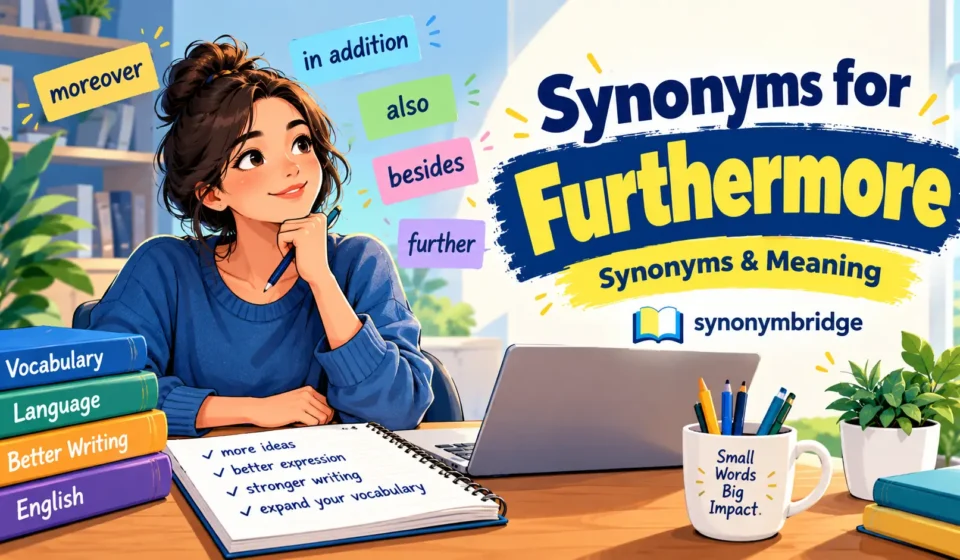
The best synonyms for furthermore are moreover, also, besides, in addition, and what is more. Each one adds a new point to what you just said. Use them to link ideas smoothly in essays, emails, and reports without repeating the same word.
Mina was finishing her essay at midnight. She had typed “furthermore” four times, and every paragraph sounded the same. Her teacher had even circled it in red. Sound familiar? She needed fresh words to join her ideas.
For example, instead of “Furthermore, the park is clean,” she wrote, “Besides, the park is clean and safe.”
“Use the right word, not its second cousin.” Mark Twain
Furthermore is a handy linking word, but too many repeats make writing feel stiff. Here is the good news: you do not need a huge vocabulary to fix this. This guide gives you 50 easy options, each with a simple meaning and two real examples.
Students can sound sharper in essays. Bloggers can keep readers interested. Content writers can avoid boring repeats. Daily English users can sound clear and polite in emails and chats.
“Brevity is the soul of wit.” William Shakespeare
1. Moreover
- Meaning: Adds a stronger or extra point to support your main idea.
- Examples:
- The shop is cheap; moreover, it is very clean.
- She sings well; moreover, she plays the guitar.
2. Additionally
- Meaning: Introduces one more fact that goes along with what you said.
- Examples:
- We need eggs; additionally, we need some milk.
- He studied hard; additionally, he slept early.
3. In addition
- Meaning: Adds another thing to the list in a simple, formal way.
- Examples:
- In addition, the hotel offers free breakfast every morning.
- In addition, Sara joined the school choir.
4. Also
- Meaning: Shows that something else is true, in the plainest way.
- Examples:
- Tom is kind; he is also very funny.
- The park also has a small lake.
5. Besides
- Meaning: Brings in an extra reason that makes your point stronger.
- Examples:
- I won’t go; besides, it is too late.
- Besides being tasty, this soup is healthy.
6. What is more
- Meaning: Adds a surprising or important extra fact to your sentence.
- Examples:
- It was fast; what is more, it was free.
- He is smart; what is more, he is humble.
7. Likewise
- Meaning: Shows that a second thing is the same as the first.
- Examples:
- Ali tidied his room; likewise, I cleaned mine.
- She said thank you; likewise, he thanked her.
8. Similarly
- Meaning: Points out that two ideas or actions work in the same way.
- Examples:
- Cats need love; similarly, dogs need daily care.
- Plants need water; similarly, people need clean air.
9. Equally important
- Meaning: Tells readers the next point matters just as much as the last.
- Examples:
- Equally important, you should drink water during the day.
- Equally important, keep your notes neat and organized.
10. Not only that
- Meaning: Warns that an even bigger or better point is coming next.
- Examples:
- Not only that, the bus was late again.
- Not only that, the room smelled wonderful.
11. On top of that
- Meaning: Piles one more point onto the ones you already gave.
- Examples:
- On top of that, we won a prize.
- On top of that, the food was free.
12. As well
- Meaning: Means “too” and is placed at the end of a sentence.
- Examples:
- I bought apples and some bananas as well.
- She speaks Urdu and English as well.
13. Plus
- Meaning: A casual word that adds a bonus point in daily talk.
- Examples:
- The movie was short, plus it was funny.
- Plus, the tickets cost very little money.
14. Again
- Meaning: Shows that you are repeating or returning to a similar idea.
- Examples:
- Again, practice matters more than talent alone.
- Again, we must thank our kind teachers.
15. Further
- Meaning: Used in formal writing to add more detail to a point.
- Examples:
- Further, the report shows a rise in sales.
- Further, students must submit their work on time.
16. In the same way
- Meaning: Shows that the second idea follows the same pattern as the first.
- Examples:
- In the same way, birds build nests for safety.
- In the same way, kids learn from play.
17. Beyond that
- Meaning: Moves on to something extra after your first main point.
- Examples:
- Beyond that, nobody knew the real answer.
- Beyond that, the trip was smooth and fun.
18. Coupled with this
- Meaning: Joins two facts together so they work as one reason.
- Examples:
- Coupled with this, rain made travel very hard.
- Coupled with this, the heat made everyone tired.
19. To add to this
- Meaning: A polite way to put one more fact on the table.
- Examples:
- To add to this, the staff were friendly.
- To add to this, prices dropped last week.
20. Another point
- Meaning: Clearly tells readers that a new idea is about to start.
- Examples:
- Another point is that exercise improves your mood.
- Another point to consider is the total cost.
21. Even more
- Meaning: Shows that the next fact is bigger or stronger than before.
- Examples:
- Even more, the team plans to grow.
- Even more surprising, the test was very easy.
22. Better still
- Meaning: Introduces an extra point that is even more pleasing to hear.
- Examples:
- The cake is soft; better still, it’s cheap.
- Better still, the hotel is near the beach.
23. Not to mention
- Meaning: Quickly adds a fact that is so clear it barely needs saying.
- Examples:
- The view is lovely, not to mention peaceful.
- He is rich, not to mention very generous.
24. By the same token
- Meaning: Says that the same reason also applies to a second case.
- Examples:
- By the same token, rules must apply to everyone.
- By the same token, workers deserve fair pay.
25. Over and above
- Meaning: Means in addition to something that is already large or required.
- Examples:
- Over and above his salary, he earns tips.
- Over and above homework, she reads daily.
26. Added to that
- Meaning: Puts one more thing on top of what was just said.
- Examples:
- Added to that, the road was closed.
- Added to that, he forgot his lunch box.
27. Along with this
- Meaning: Shows that two things come together or happen side by side.
- Examples:
- Along with this, you will get a free pen.
- Along with this, the school gave new books.
28. Apart from this
- Meaning: Leaves the main point aside and brings up another one.
- Examples:
- Apart from this, we also fixed the roof.
- Apart from this, there are no big problems.
29. Aside from that
- Meaning: A relaxed way to mention one more detail or exception.
- Examples:
- Aside from that, the trip was great fun.
- Aside from that, nothing else went wrong today.
30. Also worth noting
- Meaning: Gently points readers to a small but useful extra fact.
- Examples:
- Also worth noting, the library opens at eight.
- Also worth noting, this phone has two cameras.
31. Of equal importance
- Meaning: Tells readers the new point is just as serious as before.
- Examples:
- Of equal importance, we must protect our water.
- Of equal importance is a good night’s sleep.
32. Further to this
- Meaning: A formal phrase that continues from the point you just made.
- Examples:
- Further to this, we will send a summary.
- Further to this, please check the attached file.
33. Correspondingly
- Meaning: Shows that one thing changes in a matching way with another.
- Examples:
- Prices rose; correspondingly, sales fell a little.
- Work grew; correspondingly, the team grew too.
34. Alongside this
- Meaning: Shows that another fact is true at the very same time.
- Examples:
- Alongside this, we are building a new library.
- Alongside this, the club teaches basic coding.
35. Another thing
- Meaning: A friendly, spoken way to bring up one more idea.
- Examples:
- Another thing, please turn off the lights.
- Another thing, don’t forget your water bottle.
36. Importantly
- Meaning: Signals that the next idea is key and readers should notice it.
- Examples:
- Importantly, you should always read the instructions first.
- Importantly, the medicine must be kept cool.
37. Adding to that
- Meaning: A casual way to stack one more fact on your last one.
- Examples:
- Adding to that, the staff were very kind.
- Adding to that, parking was completely free.
38. Along those lines
- Meaning: Shows that your next idea is similar to the last one.
- Examples:
- Along those lines, we could host a book fair.
- Along those lines, try writing a daily diary.
39. To top it off
- Meaning: A fun phrase that adds the final, biggest point at the end.
- Examples:
- To top it off, we won the trophy.
- To top it off, dessert was free.
40. In fact
- Meaning: Adds a stronger fact that proves or improves what you said.
- Examples:
- He likes books; in fact, he reads daily.
- The test was easy; in fact, everyone passed.
41. Equally
- Meaning: Shows that the next idea has the same weight as the last.
- Examples:
- Equally, we should listen more than we speak.
- Equally, good manners matter in every job.
42. Indeed
- Meaning: Confirms your point and adds strength to what was just said.
- Examples:
- She is kind; indeed, everyone loves her.
- It was cold; indeed, the lake froze.
43. Notably
- Meaning: Draws attention to one special fact that stands out from the rest.
- Examples:
- Notably, the youngest student won the prize.
- Notably, sales doubled during the summer months.
44. And
- Meaning: The simplest word for joining two ideas or two actions together.
- Examples:
- I cooked rice, and she made tea.
- He opened the window and let in fresh air.
45. Next
- Meaning: Moves the reader to the following step or the following idea.
- Examples:
- Next, we will talk about spelling mistakes.
- Next, mix the flour with two eggs.
46. Together with that
- Meaning: Joins one more fact to your point so both are seen together.
- Examples:
- Together with that, we saved a lot of time.
- Together with that, the price was fair.
47. As a bonus
- Meaning: Presents an extra good thing that you did not expect.
- Examples:
- As a bonus, the hotel gave free snacks.
- As a bonus, the app is free.
48. On the same note
- Meaning: Moves smoothly to a related idea without changing the topic.
- Examples:
- On the same note, let’s talk about spelling.
- On the same note, healthy sleep helps learning.
49. What is also true
- Meaning: Introduces another fact that fits well and is equally correct.
- Examples:
- What is also true is that practice builds skill.
- What is also true is that rest matters.
50. In further support
- Meaning: Brings in more proof that backs up your main claim.
- Examples:
- In further support, the study included many students.
- In further support, experts shared similar results.
Synonyms for Furthermore in an Essay
In an essay, each linking word should match your tone. Use moreover, in addition, and further to this to add support for your thesis. Use similarly or likewise when you compare two ideas. Place the word at the start of a sentence, followed by a comma.
Do not use the same link twice in one paragraph, because repeated words make your argument feel flat and weak.
Simple Synonyms for Furthermore
If you want easy words, choose also, plus, and, besides, or as well. They are short, clear, and friendly. They work well in chats, school notes, and casual blog posts. For example, say “Plus, the tickets are cheap” instead of “Furthermore, the tickets are inexpensive.”
They also keep sentences light. Simple words help every reader follow your idea without stopping to think.
“Short words are best, and the old words when short are best of all.” Winston Churchill
Synonyms for Furthermore in Spanish
Spanish has many ways to say furthermore. The most common is además, which works in almost every situation. You can also use asimismo for formal writing, es más for strong emphasis, and de igual manera for similar ideas.
For example: “Es barato; además, es muy rico.” This means, “It is cheap; furthermore, it is very tasty.” Learning these helps you write better Spanish.
Synonyms for Furthermore in French
In French, the top choice is de plus, which is simple and polite. For formal texts, use en outre. You can also say par ailleurs to move to a new but related point, or également to mean “also.”
For example: “Il est gentil; de plus, il est drôle.” This means, “He is kind; furthermore, he is funny.” These phrases make French essays smoother.
Frequently Asked Questions
What can you say instead of “furthermore”?
You can say moreover, also, besides, in addition, or what is more. Pick the word that fits your tone. For casual talk, plus and also sound natural. For essays and reports, moreover and additionally feel more polished.
The best choice depends on your reader, so think about who will read your words before you decide. Mixing two or three different links also keeps your writing fresh.
How do you professionally say “furthermore”?
In professional emails and reports, use additionally, in addition, moreover, or further to this. These phrases sound polite and clear. They fit emails, proposals, and meeting notes. For example: “Additionally, the team will share a report on Friday.”
Avoid slang like plus with clients or managers. Keep your sentences short, and place the linking word at the start so your message stays easy to scan.
What is another academic way to say “furthermore”?
In academic writing, try moreover, in addition, equally important, or in further support. These show that you are building an argument step by step. Use similarly or by the same token when comparing evidence.
For example: “Equally important, larger samples give more reliable results.” Always follow the linking word with a clear fact, so your point feels strong and well proved.
What to say instead of “further” in an essay?
When further means “more,” you can use additional, extra, more, or added. When it means “farther,” try beyond or deeper. For example, write “additional research is needed” instead of “further research is needed.” Additional sounds the most formal and fits school essays well.
These swaps stop your essay from sounding repetitive. Choose the word that matches your meaning, and keep your sentence clear, natural, and easy to read.
Conclusion
Learning synonyms is one of the fastest ways to grow as a writer. When you know many words for furthermore, your essays flow better, your blog posts feel fresh, and your speech sounds more confident. Readers stay interested when you use different linking words instead of repeating the same one again and again.
“The limits of my language mean the limits of my world.” Ludwig Wittgenstein
Good communication is not about using big words. It is about choosing the right word at the right time. Some words fit formal emails, some fit school essays, and some fit friendly chats. With this list of 50 options, you now have a word for every situation.
Now it is time to practice. Pick five synonyms from this guide and use them in your next email, essay, or message to a friend.
Write one new sentence every day. Say it out loud, too. Small habits build strong vocabulary, and strong vocabulary builds confidence. Keep this list close, and come back whenever you feel stuck.
“A word after a word after a word is power.” Margaret Atwood
Keep learning, keep practicing, and enjoy every new word you add to your toolbox.