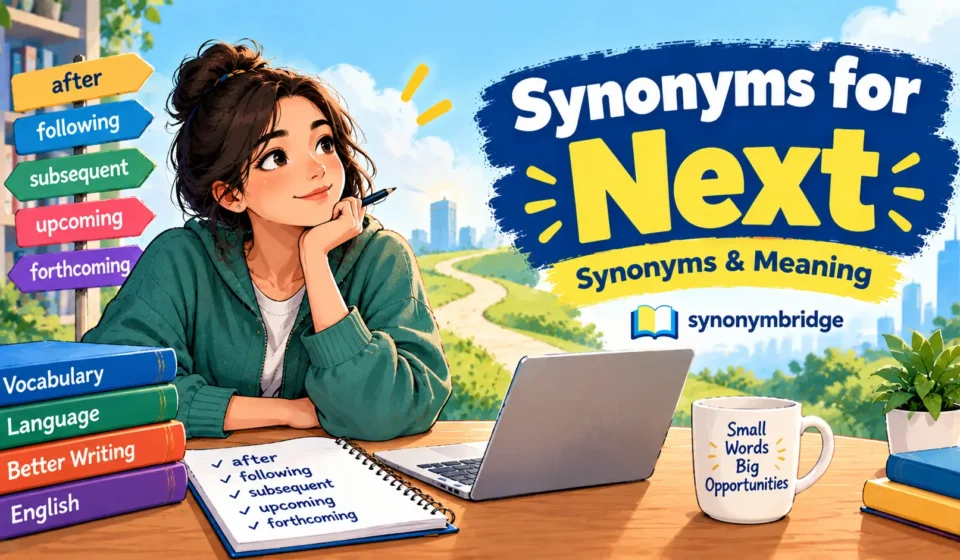
Common synonyms for next include following, subsequent, upcoming, later, then, and afterward. These words describe what comes right after something in time, order, or place. For example, you can say the following day or the subsequent step instead of repeating next again and again in your writing.
Maya read her own essay and frowned. Every sentence began with the word next. Next, she did this. Next, she did that. It sounded like a broken record, and she kept running out of fresh options.
She wanted her writing to flow smoothly. A simple word swap fixed the problem in minutes.
“The difference between the almost right word and the right word is really a large matter.” Mark Twain
Here is a simple real life example. Instead of writing “next, we packed our bags,” you can write “afterward, we packed our bags.” The meaning stays clear, but the sentence feels fresh.
“Words are, of course, the most powerful drug used by persons.” Rudyard Kipling
Synonyms for next help everyone. Students write stronger essays. Bloggers keep readers interested. Content writers avoid boring repeats. Daily English users sound more confident. Each word below comes with a short meaning and two easy examples.
1. Following
Meaning: Coming right after something else in order or in time.
Examples:
- Please read the following steps before you begin.
- The following day was bright and very calm.
2. Subsequent
Meaning: Happening after something else, often as a result of it.
Examples:
- Subsequent tests showed much better results overall.
- Subsequent chapters explain the rules in more detail.
3. Succeeding
Meaning: Coming after another thing and taking its place in line.
Examples:
- Each succeeding year brought new friends and fun.
- The succeeding speaker told a funny story.
4. Ensuing
Meaning: Happening afterward, usually because of an earlier event or action.
Examples:
- The ensuing noise woke the whole house.
- She smiled during the long ensuing silence.
5. Successive
Meaning: Following one after another with no break in between them.
Examples:
- Our team won three successive games last month.
- It rained on four successive days this week.
6. Consecutive
Meaning: Following in a clear order, one right after the other.
Examples:
- Write the consecutive numbers from one to ten.
- He studied for five consecutive nights before exams.
7. Upcoming
Meaning: About to happen soon or coming in the near future.
Examples:
- I am nervous about my upcoming exam.
- Check the poster for upcoming school events.
8. Forthcoming
Meaning: Going to happen soon, often used for planned events or books.
Examples:
- Her forthcoming book will arrive in spring.
- We will share details at the forthcoming meeting.
9. Coming
Meaning: Going to happen or arrive soon after the present moment.
Examples:
- Plan your work for the coming week.
- The coming winter looks colder than last year.
10. Approaching
Meaning: Getting closer in time, so it will happen very soon.
Examples:
- The approaching storm made everyone head indoors.
- We are busy with the approaching deadline.
11. Later
Meaning: At a time after now or after something else happens.
Examples:
- Let’s talk about this later in the evening.
- Later, we ate ice cream by the lake.
12. Afterward
Meaning: At a later time, after something else has already happened.
Examples:
- We watched the film and went home afterward.
- Afterward, she thanked everyone for coming so early.
13. Afterwards
Meaning: The British way to say afterward, meaning later or following that.
Examples:
- Tea and biscuits are served shortly afterwards.
- He felt much calmer a few hours afterwards.
14. Thereafter
Meaning: From that time on, or soon after that moment in time.
Examples:
- She moved abroad and thereafter wrote every week.
- Thereafter, the town grew bigger each year.
15. Subsequently
Meaning: Happening at a later time, after something else took place.
Examples:
- He lost his keys and subsequently missed the bus.
- The shop closed and subsequently reopened downtown.
16. Then
Meaning: At that next moment, or after that point in time.
Examples:
- Mix the flour, then add the eggs.
- First we ate, then we played outside.
17. After That
Meaning: A simple phrase that moves the story to the next step.
Examples:
- After that, we cleaned the whole kitchen.
- After that, the bell rang for lunch.
18. Right After
Meaning: Happening just a short moment after something else has finished.
Examples:
- Call me right after the meeting ends.
- She left right after the final song.
19. Soon After
Meaning: A short time later, but not at the same moment.
Examples:
- Soon after lunch, the rain began to fall.
- They arrived soon after the show started.
20. Shortly After
Meaning: Not long after something else has happened or been done.
Examples:
- Shortly after dinner, he fell fast asleep.
- The bus left shortly after we sat down.
21. Straight After
Meaning: Immediately following something, with no waiting time in between at all.
Examples:
- I do my homework straight after school.
- Brush your teeth straight after you eat.
22. Later On
Meaning: At some point in the future, but not right now.
Examples:
- You will understand this later on in life.
- We can pick a movie later on.
23. Thereupon
Meaning: Right after something happens, and often because of that event.
Examples:
- He opened the door and thereupon stepped outside.
- The judge spoke, and thereupon everyone stood up.
24. Second
Meaning: Coming right after the first one in a list or order.
Examples:
- The second step is to stir the soup.
- She finished second in the school race.
25. Secondly
Meaning: Used to introduce your next point after you say firstly.
Examples:
- Firstly, it is cheap; secondly, it is fast.
- Secondly, we need to check the facts.
26. Additionally
Meaning: Used to add one more point to what you just said.
Examples:
- Additionally, the hotel offers a free breakfast.
- Additionally, students may bring a small snack.
27. Furthermore
Meaning: A formal word that adds a stronger point to your argument.
Examples:
- Furthermore, the plan saves both time and money.
- Furthermore, our team has years of experience.
28. Moreover
Meaning: A formal word used to add an extra and important idea.
Examples:
- Moreover, the park is free for all visitors.
- Moreover, he works harder than anyone I know.
29. In Addition
Meaning: A common phrase that adds one more fact to the list.
Examples:
- In addition, we will need two more chairs.
- In addition, the room has a nice view.
30. Also
Meaning: A simple word that means too, or in addition to this.
Examples:
- She sings, and she also plays the piano.
- We also need milk from the shop.
31. Besides
Meaning: Used to give another reason or add something to your point.
Examples:
- Besides, it is too late to go out.
- Besides reading, he enjoys swimming and cycling.
32. Plus
Meaning: A casual word used to add one more good thing.
Examples:
- The pizza was hot, plus it was cheap.
- Plus, we get to sit near the window.
33. Further
Meaning: Used to add more information or to move to the next point.
Examples:
- Further, the report explains how to fix it.
- Read further down for more helpful tips.
34. Adjacent
Meaning: Lying very close to something else, often right beside it.
Examples:
- Our house is adjacent to the park.
- She sat in the adjacent seat on the train.
35. Adjoining
Meaning: Sharing a wall or border with another room, place, or space.
Examples:
- We booked two adjoining rooms at the hotel.
- The adjoining field belongs to my uncle.
36. Neighboring
Meaning: Located close by, next to or near your own place.
Examples:
- Children from neighboring villages joined the game.
- The neighboring shop sells fresh bread daily.
37. Nearest
Meaning: Having the shortest distance from you or from another place.
Examples:
- Where is the nearest bus stop from here?
- He called the nearest hospital for help.
38. Closest
Meaning: Being at the smallest distance, or most near in connection.
Examples:
- My closest friend lives across the street.
- Park in the closest spot to the door.
39. Immediate
Meaning: Happening right now, or coming right next with no delay.
Examples:
- The patient needs immediate help from a doctor.
- Our immediate plan is to finish the report.
40. Alongside
Meaning: Right next to something, or together with it at once.
Examples:
- She walked alongside her brother to school.
- Serve the rice alongside the spicy curry.
41. Beside
Meaning: At the side of someone or something, very close by.
Examples:
- Please sit beside me during the show.
- The lamp stands beside the old sofa.
42. Next Door
Meaning: Living or located in the house or building right beside yours.
Examples:
- My best friend lives next door to me.
- The kids next door play loud music.
43. Up Next
Meaning: A casual phrase for what will happen or appear after this.
Examples:
- Up next, we have a quick math quiz.
- Stay tuned because the best song is up next.
44. Next Up
Meaning: Another casual phrase for the person or thing coming after this one.
Examples:
- Next up on the stage is our school choir.
- You are next up, so get ready.
45. Coming Up
Meaning: A phrase used when something will happen or be shown very soon.
Examples:
- Coming up, we will share three quick tips.
- Exams are coming up in two weeks.
46. From There
Meaning: Starting at that point and moving on to the next step.
Examples:
- Turn left, and from there, walk straight.
- She began as an intern; from there, she rose.
47. Onward
Meaning: Moving forward in space or time, from this point toward what comes next.
Examples:
- From Monday onward, we start at nine.
- The road continues onward through the green hills.
48. Ahead
Meaning: In front of you, or coming in the near future.
Examples:
- There is a long road ahead of us.
- Good days are ahead, so keep trying.
49. Down the Line
Meaning: At some later time in the future, often after many steps.
Examples:
- We may add more rooms down the line.
- Down the line, this skill will help you.
50. Next in Line
Meaning: The person or thing that will be served or chosen after the current one.
Examples:
- You are next in line at the counter.
- He is next in line for the job.
Now that you have seen 50 options, notice how each one fits a different mood and moment.
“The limits of my language mean the limits of my world.” Ludwig Wittgenstein
Synonyms for Next Steps
When you share a plan, next steps can sound repetitive. Try follow up actions, action items, upcoming tasks, or a way forward. In business, subsequent measures sound professional. At home, what to do next feels friendlier.
For example: “Our follow up actions are listed below.” Choose the phrase that matches your reader and tone. Each option gives the reader a clear path forward.
Synonyms for Next Level
Saying next level means something is better than before. You can swap it for advanced, higher tier, superior, elevated, or top notch. For a casual tone, use a step up or leveled up. For example: “The advanced class starts tomorrow.”
These choices work well in gaming, fitness, business, and school writing because they all show growth and progress in a clear, simple way.
Synonyms for Next Time
Need another way to say next time? Try the following time, on the next occasion, in the future, from now on, or another time. For a polite tone, at a later date works nicely. For example: “From now on, I will bring snacks.”
These phrases are handy in emails, apologies, and promises, since they point clearly toward a better moment ahead.
Synonyms for Next Chapter
The next chapter can mean a fresh start in life or in a story. Good swaps include new phase, new beginning, fresh start, following stage, and new era. For example: “She is ready for a new phase.”
Writers love these phrases in speeches, resumes, and social media captions, because they sound hopeful and warm. They also help you avoid repeating the same expression too often.
Synonyms for Next Generation
Next generation describes what comes after the current version. Useful synonyms are future, new age, modern, cutting edge, emerging, and successor. For example: “This phone is our new age model.”
You can also say the coming generation when talking about young people. Technology writers, teachers, and parents use these words often. Each one fits a slightly different situation, so knowing them makes your writing clearer and richer.
FAQ
How do you say next in a formal way?
In formal writing, replace next with following, subsequent, or thereafter. These words sound polished in reports, emails, and essays. For example, write “the following section” instead of “the next section.”
In speech, you can say subsequently or after this. Formal tone is about choosing clear, respectful words, so avoid slang phrases such as “up next” in serious documents and business letters.
What’s another transition word for next?
Good transition words for next include then, after that, afterward, following this, and subsequently. Use first, second, and finally to keep steps in order. In essays, furthermore and moreover add new points.
For example: “First, mix the flour. Second, add the eggs.” Transition words guide readers smoothly from one idea to the next, so they never feel lost. Pick one that fits your topic.
What is a formal synonym for “next”?
The best formal synonym depends on how you use the word. As an adjective, subsequent or succeeding fits well, like “the subsequent meeting.” As an adverb, subsequently or thereafter works better. For place or position, adjacent is a formal choice.
Matching the word type to your sentence keeps your grammar clean and your tone professional. Always check that the word fits the sentence before you publish.
What is another way to say “then” or “next”?
To replace then, try after that, afterward, later, or soon after. To replace next, try following, up next, or coming up. For storytelling, later that day or before long can move the plot forward. For example: “Before long, the rain stopped.” Mixing these phrases keeps your sentences lively and stops readers from feeling bored. Casual chats and stories welcome these simple, friendly choices.
Conclusion
Learning synonyms for next does more than make your writing look smart. It makes every sentence clearer, smoother, and more enjoyable to read. When you pick the right word, your blog posts flow better, your speeches sound stronger, and your daily conversations feel more natural.
Synonyms also help you avoid repeating yourself, which keeps readers interested until the very last line.
“One day I will find the right words, and they will be simple.” Jack Kerouac
Now it is your turn to practice. Pick five words from this list and use them in your next email, school essay, or social media post. Try one new word each day, and say it aloud in conversation. Small habits like this build a rich vocabulary over time, and you will soon notice how confident you feel.
“The pen is mightier than the sword.” Edward Bulwer Lytton
Keep this guide handy, and return to it whenever your writing needs a fresh spark. With 50 helpful options, you will never run out of ways to move your ideas forward. Happy writing, and keep learning one word at a time!