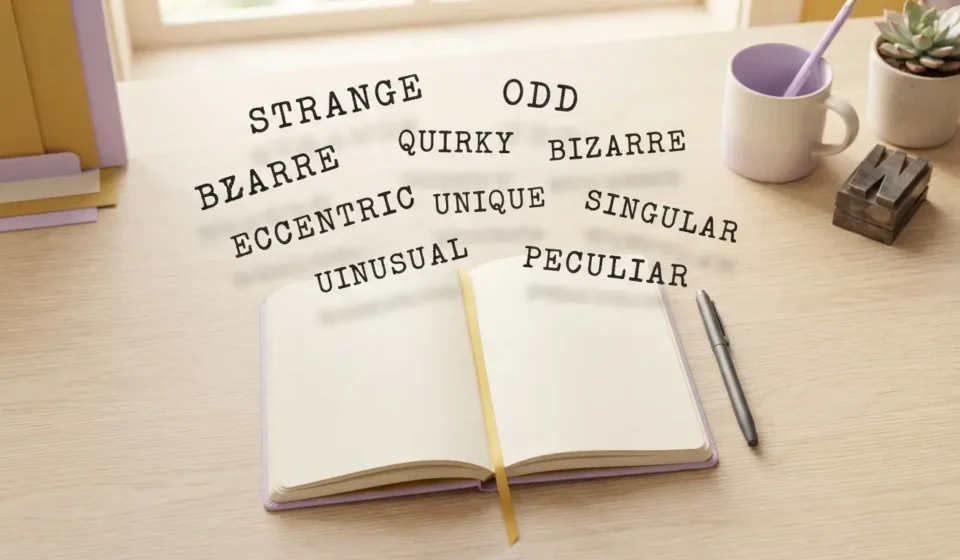
A synonym for weird is any word that means strange, odd, or unusual. Common choices include strange, bizarre, peculiar, quirky, and eccentric. These words describe people, things, or events that do not seem normal. Writers use them to add variety and avoid repeating the same word again and again.
Picture this: your neighbor waters his plants at midnight, wearing a raincoat, on a sunny day. You watch from your window and think, “That’s… different.” Your brain reaches for a word, but “weird” feels too plain for the moment. That’s where synonyms step in and save the sentence.
Here’s a simple example. Instead of saying “the movie was weird,” you could say “the movie was surreal.” One small swap, and the sentence suddenly feels sharper and more precise.
Learning these words matters for many people. Students use them to sound smarter in essays. Bloggers use them to keep readers interested and scrolling.
Content writers use them to avoid repeating one tired word across a whole article. Daily English users use them to describe odd moments in a fun, natural way.
“Words are the clothes that thoughts wear when they leave the mind.”
Once you build a small collection of these words, your writing and speech both grow stronger. You stop leaning on the same three words and start choosing the exact shade of meaning you want.
“To be different is not a flaw; it is simply another way of being right.”
This guide gives you 55 solid options, grouped meanings, and real examples so you can start using them today.
Main Synonyms List
1. Strange

Meaning: Something that feels unfamiliar or hard to explain in a normal way.
Examples: The old house had a strange smell. She gave me a strange look.
2. Odd
Meaning: Different from what people expect or consider normal behavior.
Examples: He has an odd habit of humming. That was an odd choice, honestly.
3. Bizarre
Meaning: Very strange in a way that shocks or confuses people.
Examples: The dream felt bizarre and hard to follow. Their excuse sounded truly bizarre.
4. Peculiar
Meaning: Unusual in a specific and noticeable way that stands out.
Examples: The clock made a peculiar ticking sound. His accent was somewhat peculiar.
5. Unusual
Meaning: Not common, not typical, and different from everyday events.
Examples: It was an unusually quiet morning. She wore an unusual outfit today.
6. Curious
Meaning: Strange in a way that makes people want to know more.
Examples: There was a curious mark on the wall. He gave a curious answer.
7. Eccentric
Meaning: Someone who acts and thinks differently than most other people.
Examples: My uncle is a lovable eccentric artist. Her eccentric style turns heads instantly.
8. Quirky
Meaning: Slightly odd in a charming, fun, and likable way.
Examples: The cafe has a quirky vintage theme. He has a quirky sense of humor.
9. Freakish
Meaning: Extremely unusual, sometimes in a shocking or unsettling manner.
Examples: The storm brought freakish winds overnight. That coincidence felt almost freakish, honestly.
10. Uncanny
Meaning: Strange in a way that feels mysterious or slightly unsettling.
Examples: The twins share an uncanny resemblance. Her timing was uncanny that day.
11. Wacky
Meaning: Silly and strange in a lighthearted, funny sort of way.
Examples: The comedy had a wacky, chaotic plot. He wore a wacky costume on Friday.
12. Zany
Meaning: Amusingly strange, wild, and full of playful energy.
Examples: The show is known for zany characters. Their zany plan somehow worked out.
13. Outlandish
Meaning: So unusual that it seems almost unbelievable or over the top.
Examples: His outlandish claim shocked the whole room. The outfit looked outlandish for a wedding.
14. Offbeat
Meaning: Different from the usual style, path, or way of thinking.
Examples: They chose an offbeat honeymoon destination. The film has an offbeat storyline.
15. Kooky
Meaning: Mildly strange and eccentric, often in a friendly way.
Examples: Grandpa tells kooky stories at dinner. She has a kooky collection of hats.
16. Oddball
Meaning: A person or thing that does not fit the usual pattern.
Examples: He’s the oddball of the group. It was an oddball request, frankly.
17. Abnormal
Meaning: Not matching the normal or expected pattern of something.
Examples: The test showed abnormal results again. Her behavior seemed abnormal that week.
18. Unconventional
Meaning: Not following the usual rules, methods, or accepted traditions.
Examples: She took an unconventional path to success. His teaching style is quite unconventional.
19. Unorthodox
Meaning: Different from standard beliefs, methods, or common accepted practice.
Examples: The coach tried an unorthodox training method. His views are somewhat unorthodox today.
20. Irregular
Meaning: Not following a normal pattern, shape, or steady schedule.
Examples: Her heartbeat felt irregular for a moment. The bus schedule seemed oddly irregular.
21. Fantastic
Meaning: So strange or extreme that it feels almost imaginary.
Examples: The story had a fantastic, dreamlike quality. His excuse sounded almost fantastic, honestly.
22. Grotesque
Meaning: Strange and unpleasant to look at or think about.
Examples: The statue had a grotesque, twisted face. The scene felt grotesque and unsettling.
23. Surreal
Meaning: So strange it feels like a dream, not real life.
Examples: Winning the award felt completely surreal. The foggy street looked oddly surreal.
24. Baffling
Meaning: So confusing and strange that it is hard to understand.
Examples: The math puzzle was truly baffling. His sudden silence felt baffling too.
25. Puzzling
Meaning: Strange enough that it leaves people confused or curious.
Examples: The note left a puzzling message. Her reaction was puzzling, to say the least.
26. Mysterious
Meaning: Strange because the cause or reason is unknown or hidden.
Examples: A mysterious light appeared in the sky. He gave a mysterious little smile.
27. Cryptic
Meaning: Strange and hard to understand, almost like a secret code.
Examples: She sent a cryptic text last night. His cryptic reply confused everyone present.
28. Enigmatic
Meaning: Mysterious and strange in a way that is hard to figure out.
Examples: The painter lived an enigmatic, quiet life. His enigmatic answer left us guessing.
29. Random
Meaning: Strange because it happens without any clear plan or pattern.
Examples: He made a random comment about spaceships. It was a random, odd coincidence.
30. Off kilter
Meaning: Slightly strange or unbalanced compared to what feels normal.
Examples: The whole meeting felt a bit off kilter. His mood seemed off kilter today, somehow.
31. Out of the ordinary
Meaning: Different from what usually happens on a normal day.
Examples: It was an out of the ordinary request from him. Nothing out of the ordinary happened at work today.
32. Screwy
Meaning: Strange, confusing, or not working the way it should.
Examples: The whole plan sounded pretty screwy. His logic felt screwy from the start.
33. Nutty
Meaning: Slightly crazy or strange in a silly, harmless way.
Examples: That’s a nutty idea, but fun. He came up with a nutty nickname.
34. Loony
Meaning: Very strange or foolish, often used in a joking tone.
Examples: The whole scheme sounded loony to me. She had a loony grin on.
35. Crazy
Meaning: Wild or strange enough to seem hard to believe fully.
Examples: That was a crazy coincidence, honestly. His crazy schedule leaves no free time.
36. Wild
Meaning: Strange, extreme, or surprising in an intense sort of way.
Examples: The party got wild fast that night. It’s a wild story, actually.
37. Fishy
Meaning: Strange in a way that makes something feel suspicious.
Examples: His story sounded a little fishy. Something fishy is going on here.
38. Unnatural
Meaning: Strange because it does not match what feels normal or expected.
Examples: The silence in the house felt unnatural. Her calmness seemed unnatural, honestly.
39. Preternatural
Meaning: Strange enough to seem beyond everyday human ability.
Examples: He showed preternatural skill on the piano. Her calm felt almost preternatural today.
40. Otherworldly
Meaning: So strange it seems to belong to another world entirely.
Examples: The cave glowed with an otherworldly light. Her voice sounded soft, otherworldly, calm.
41. Alien
Meaning: Strange because it feels unfamiliar or completely out of place.
Examples: The custom felt alien to the tourists. His methods seemed alien to us.
42. Exotic
Meaning: Strange and interesting because it comes from somewhere unfamiliar.
Examples: The market sold exotic spices and fruits. Her exotic style stood out instantly.
43. Anomalous
Meaning: Strange because it does not match the usual, expected pattern.
Examples: Scientists noted an anomalous reading overnight. The results seemed anomalous compared to last month.
44. Aberrant
Meaning: Strange because it strays from what is normal or expected.
Examples: The doctor flagged an aberrant cell pattern. His aberrant behavior worried his coworkers.
45. Deviant
Meaning: Strange because it moves away from usual social standards.
Examples: The report described deviant traffic patterns downtown. His deviant choices confused his family.
46. Freaky
Meaning: Strange enough to feel a little scary or unsettling.
Examples: That coincidence was honestly kind of freaky. The old house felt freaky at night.
47. Spooky
Meaning: Strange in a way that feels a little scary or eerie.
Examples: The abandoned school looked spooky at dusk. A spooky silence filled the hallway.
48. Eerie
Meaning: Strange and a little frightening, often in a quiet way.
Examples: An eerie fog covered the empty street. The silence felt eerie and heavy.
49. Creepy
Meaning: Strange in a way that makes your skin feel uneasy.
Examples: The doll’s stare felt creepy somehow. That basement always feels a bit creepy.
50. Unearthly
Meaning: So strange it seems to not belong to this earth.
Examples: The howling wind made an unearthly sound. Her pale skin looked almost unearthly.
51. Whimsical
Meaning: Strange in a playful, imaginative, and lighthearted kind of way.
Examples: The garden had a whimsical, fairy tale feel. His whimsical drawings made everyone smile.
52. Wonky
Meaning: Strange because something seems slightly off, broken, or unstable.
Examples: The table has one wonky leg. My internet connection felt wonky today.
53. Erratic
Meaning: Strange because it changes suddenly without any clear pattern.
Examples: His driving felt erratic on the highway. Her erratic mood confused her friends.
54. Idiosyncratic
Meaning: Strange because it reflects one person’s very unique personal habits.
Examples: He has an idiosyncratic way of writing. Her idiosyncratic taste in music surprised us.
55. Unheard of
Meaning: So strange or rare that it rarely happens normally.
Examples: Winning twice in a row felt unheard of. That level of kindness seemed unheard of.
“The strangest people often carry the most interesting stories inside them.”
Synonyms for Weird Person
Some people simply stand out from the crowd, and English gives us plenty of ways to describe them. Words like eccentric, oddball, and character all point to a person who thinks or acts differently.
These terms can sound playful or respectful, depending on tone. Use “eccentric” for someone charmingly unusual, or “oddball” for a lighthearted nickname among friends. Choosing the right word helps you describe personality without sounding harsh or unkind.
Synonyms for Weird in a Good Way
Not all strangeness is negative. Words like quirky, whimsical, and unique describe things that feel charming instead of off putting. A quirky friend might collect unusual mugs, and a whimsical outfit might turn heads in a fun way.
These words celebrate individuality rather than criticize it. They work well in blog posts, product descriptions, and casual conversation when you want to praise someone’s originality warmly.
Synonyms for Weird Behavior

When actions don’t match what people expect, words like erratic, abnormal, and irregular describe that shift clearly. Erratic behavior might mean sudden mood changes, while irregular habits suggest a broken routine.
These words are useful in workplace notes, health discussions, or storytelling. They help writers explain unpredictable actions without guessing at the reason behind them, keeping the description factual and easy to understand.
Synonyms for Weird Feeling
Sometimes strangeness lives inside us, not around us. Words like uncanny, unsettling, and off describe that odd internal sense that something isn’t right.
An uncanny feeling might come from déjà vu, while an unsettling feeling might follow a strange dream. These words help writers capture emotion precisely, especially in personal essays, journals, or fiction where inner experience matters most.
Formal Synonyms for Weird
Professional writing often needs a more polished word than “weird.” Terms like anomalous, atypical, and irregular fit reports, research papers, and business emails. “Anomalous” suits scientific writing, while “atypical” works well in medical or workplace contexts.
These words keep your tone professional while still describing something that clearly breaks from the expected pattern or standard.
Frequently Asked Questions
How do you say weird in a nice way?

Use gentle, positive words like quirky, unique, or whimsical. These describe someone’s unusual traits as charming rather than negative. For example, “She has a quirky style” sounds friendly and complimentary. This approach works well when describing friends, coworkers, or characters you genuinely admire, without sounding critical or dismissive of their personality.
What is a synonym for not normal?
Good options include abnormal, irregular, and atypical. These words describe something that breaks from the usual pattern without adding strong emotion.
“Abnormal” often appears in medical or technical writing, while “atypical” feels slightly softer. Choose based on how formal or clinical your sentence needs to sound.
What is another slang word for “weird”?
Casual slang options include wacky, kooky, and screwy. These words feel relaxed and fit spoken conversation or informal writing perfectly. “Wacky” often describes silly humor, while “screwy” suggests something confusing or off. Both add personality and energy to everyday chats or social media captions.
What is a better word for unusual?
Try uncommon, rare, or distinctive depending on context. “Uncommon” works for general situations, “rare” suits special or infrequent events, and “distinctive” highlights something memorable and standout. Each option shifts the tone slightly, so pick one that matches how positive or neutral you want the sentence to feel.
Conclusion
Learning synonyms like these does more than fill space in a sentence. It sharpens your writing, strengthens your speaking, and helps every message land with more color and precision. Instead of repeating “weird” five times in one blog post, you now have 55 fresh options ready to use.
This skill pays off everywhere. Better word choice makes essays feel more mature, blog posts feel more engaging, and everyday conversations feel more natural and expressive.
Even small swaps, like choosing “quirky” over “weird,” change how warm or playful your sentence feels.
Try using a few new words this week. Drop “peculiar” into an email, describe a friend as “whimsical,” or call a strange coincidence “uncanny.” Small practice like this builds a habit that lasts.
“Language grows richer the moment we stop settling for the first word that comes to mind.”
Keep this list nearby, revisit it often, and let your vocabulary grow one strange, wonderful word at a time.
“The right word, chosen with care, can turn an ordinary sentence into something memorable.”