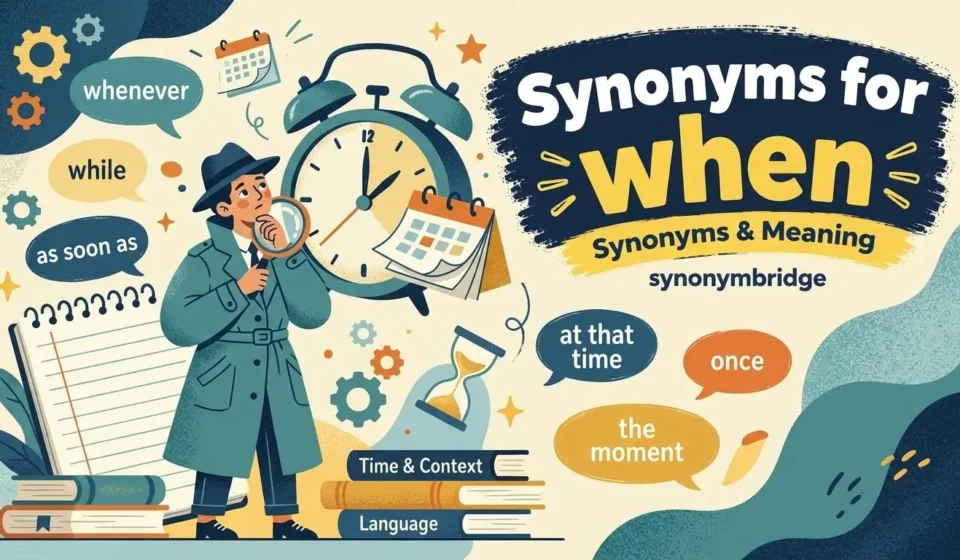
Common synonyms for when include while, once, as, and whenever. These words show time in a sentence. Use while for things happening together, once for after something ends, and whenever for any time. Pick the one that best fits your meaning.
Maya read her essay aloud and winced. Three sentences in a row started with “when.” The story was good, but the rhythm felt flat. One swap, like “once” or “as soon as,” made the whole paragraph sparkle.
“The difference between the almost right word and the right word is really a large matter.” Mark Twain
Here is a simple example: “I smile when it rains” becomes “I smile whenever it rains.” The idea stays the same, but the feel changes. Better time words help in four ways:
- Students: sharper essays and stronger exam answers.
- Bloggers: smoother posts that readers finish.
- Content writers: less repetition and more variety.
- Daily English users: clearer speech and messages.
“Better three hours too soon than a minute too late.” William Shakespeare
Let’s explore the best options.
1. While
- Meaning: Shows that two things are happening at the very same time.
- Examples: She sang happily while he cooked dinner. Please wait here while I find the key.
2. Whenever
- Meaning: Means at any time or every single time something happens.
- Examples: Call me whenever you need some help. Whenever it snows, the kids run outside.
3. As
- Meaning: Shows that one thing happens during another thing, at once.
- Examples: He waved as the train left the station. The sky grew dark as night came.
4. Once
- Meaning: Shows that one thing happens after another thing is finished.
- Examples: Once the bell rings, we can go home. Call me once you reach the hotel.
5. As soon as
- Meaning: Means right after something happens, with no waiting at all.
- Examples: Text me as soon as you land safely. We left as soon as it stopped raining.
6. The moment
- Meaning: Means the exact second that something happens or begins.
- Examples: The moment she smiled, I felt much better. He ran the moment he heard it.
7. The instant
- Meaning: Shows that something happens in a split second after another thing.
- Examples: The instant the lights went out, everyone screamed. I knew the instant I saw her.
8. At the time
- Meaning: Points to a specific moment in the past or future.
- Examples: I was in school at the time. Prices were low at the time.
9. At which time
- Meaning: A formal way to point back to a moment just mentioned.
- Examples: Class ends at noon, at which time lunch begins. We meet Friday, at which time we decide.
10. Whilst
- Meaning: An old fashioned or British word that means the same as while.
- Examples: He read a book whilst waiting for the bus. Whilst we talked, the tea went cold.
11. After
- Meaning: Shows that something happens later than another event or action.
- Examples: We played outside after we finished our homework. After lunch, she took a short nap.
12. Before
- Meaning: Shows that something happens earlier than another event or action.
- Examples: Wash your hands before you eat anything. Call me before you leave the office.
13. Until
- Meaning: Shows that something continues up to a certain point in time.
- Examples: Stay here until the rain finally stops. I waited until midnight for her call.
14. By the time
- Meaning: Means at or before a certain moment, often with a result.
- Examples: By the time we arrived, the show had started. By the time you read this, I’m gone.
15. Each time
- Meaning: Points to every single occasion when something happens again and again.
- Examples: Each time I visit, she bakes fresh bread. Each time he tried, he improved.
16. Every time
- Meaning: Means on all occasions, with no exception, whenever it happens.
- Examples: Every time I hear that song, I smile. The dog barks every time the doorbell rings.
17. Any time
- Meaning: Means at whatever moment you choose, with no fixed schedule.
- Examples: You can visit any time you feel like it. Any time you’re ready, we’ll start.
18. On the occasion that
- Meaning: A formal phrase for a specific event or situation that happens.
- Examples: On the occasion that you win, we’ll celebrate. Bring a coat on the occasion that it’s cold.
19. In the event that
- Meaning: Used for something that might happen, so you should be ready.
- Examples: In the event that it rains, use the umbrella. Call us in the event that you’re late.
20. If
- Meaning: Shows a condition that must be true for something else to happen.
- Examples: If you study hard, you will pass the test. We’ll stay home if it snows.
21. Provided that
- Meaning: Means only if a certain condition is met first.
- Examples: You can go out provided that you finish chores. Provided that it’s sunny, we’ll have a picnic.
22. Given that
- Meaning: Shows a fact that explains why something else makes sense.
- Examples: Given that she was tired, she went home early. Given that it’s Sunday, shops may be closed.
23. Considering that
- Meaning: Shows that you are thinking about a fact before judging something.
- Examples: Considering that he’s new, he did very well. Considering that it’s cheap, it’s quite good.
24. Since
- Meaning: Shows the starting point of something that continues until now.
- Examples: I’ve lived here since I was a small child. Since you called, my day got better.
25. Whereas
- Meaning: Used to compare two different facts or ideas side by side.
- Examples: She loves tea, whereas her brother prefers coffee. Summer is hot, whereas winter is cold.
26. During
- Meaning: Means throughout the time that something else is going on.
- Examples: Please stay quiet during the movie. He called twice during our family dinner.
27. Throughout
- Meaning: Means from the beginning to the end of a period.
- Examples: It rained throughout the whole weekend trip. She smiled throughout the long speech.
28. Meanwhile
- Meaning: Shows that something else is happening at the same time elsewhere.
- Examples: Dad cooked dinner. Meanwhile, I cleaned the table. Meanwhile, the cat slept on the sofa.
29. Then
- Meaning: Points to a time in the past or the next step.
- Examples: We ate lunch, then we went for a walk. I was young then.
30. Afterward
- Meaning: Means at a later time, after something has already happened.
- Examples: We watched the game and played cards afterward. Afterward, everyone went home happy.
31. Subsequently
- Meaning: A formal word that means later or after something earlier happened.
- Examples: He subsequently moved to another city. The rule was subsequently changed by the school.
32. Following
- Meaning: Means coming right after something else, in time or order.
- Examples: Following the speech, everyone clapped loudly. Following lunch, we cleaned the kitchen together.
33. Upon
- Meaning: A formal word for right after something happens or starts.
- Examples: Upon arrival, please check in at the desk. Upon hearing the news, she cried.
34. As long as
- Meaning: Means during the whole time that a condition stays true.
- Examples: You can stay as long as you like. I’ll wait as long as it takes.
35. So long as
- Meaning: Means only on the condition that something remains true.
- Examples: Borrow it so long as you return it. So long as we’re together, I’m happy.
36. Just as
- Meaning: Means at the exact same moment that something else happened.
- Examples: The phone rang just as I sat down. Just as we left, the sun came out.
37. Right when
- Meaning: A casual way to say at the exact moment something happens.
- Examples: The bus came right when I reached the stop. Right when I relaxed, the alarm rang.
38. Immediately after
- Meaning: Means with no gap at all following something that just happened.
- Examples: Brush your teeth immediately after eating sweets. He left immediately after the meeting ended.
39. Directly after
- Meaning: Means straight after something, with nothing happening in between them.
- Examples: We went home directly after the concert. Directly after class, I met my friend.
40. At that point
- Meaning: Points to a certain moment in a story or process.
- Examples: At that point, I decided to quit. At that point, nobody knew the answer.
41. At this moment
- Meaning: Means right now, at the present time of speaking.
- Examples: At this moment, I’m very busy. At this moment, the team is winning.
42. At one time
- Meaning: Refers to a period in the past that is now over.
- Examples: At one time, this street was a farm. At one time, he lived abroad.
43. Back then
- Meaning: Means in the past, during a period you are remembering fondly.
- Examples: Back then, we walked to school every day. Back then, phones were very simple.
44. In case
- Meaning: Means as a safe step because something might possibly happen later.
- Examples: Take a jacket in case it gets cold. Keep my number in case you’re lost.
45. Whereupon
- Meaning: A formal word meaning right after which, something else then happened.
- Examples: He told a joke, whereupon everyone laughed. She stood up, whereupon the crowd cheered.
46. Whensoever
- Meaning: An old style word for at any time at all.
- Examples: Whensoever you need me, I will come. Return whensoever you feel ready again.
47. In times of
- Meaning: Means during a period when something hard or special is happening.
- Examples: Friends help in times of trouble. In times of joy, we celebrate together.
48. In the course of
- Meaning: Means during the process of something that takes some time.
- Examples: In the course of our talk, we laughed often. In the course of work, he learned much.
49. Right as
- Meaning: Means at the exact moment something else is taking place.
- Examples: Right as I sat down, the movie began. Right as she spoke, thunder rolled.
50. As often as
- Meaning: Means every time something is possible, again and again.
- Examples: Visit as often as you can manage. She calls her mom as often as possible.
51. Just after
- Meaning: Means very soon after something else has happened or finished.
- Examples: We arrived just after the shop closed. It rained just after we got inside.
52. Soon after
- Meaning: Means a short time later than a certain event.
- Examples: Soon after dinner, the guests went home. Soon after moving, he found a job.
53. Later
- Meaning: Means at a time that comes after now or after another event.
- Examples: Let’s talk about it later tonight. Later, she became a famous writer.
54. On the day that
- Meaning: Points to one exact day when something special or important happens.
- Examples: On the day that we met, it snowed. Call me on the day that you land.
55. The minute
- Meaning: A casual way to say the very moment something happens.
- Examples: The minute I saw him, I smiled. Text me the minute you’re home.
Synonyms for When Possible
When you say “when possible,” you mean “if it can be done.” Good swaps include “if possible,” “where possible,” and “whenever you can.” They keep the polite tone but sound a little fresher.
In emails, try “as soon as you’re able.” For instructions, “wherever possible” works well and sounds clear and professional.
Synonyms for When in Reality
Use these words to compare ideas with the real world. Strong options are “in fact,” “actually,” and “in truth.” You can also say “in real life” for a casual feel. For example: “He seems calm, but in fact he is nervous.” These phrases help your reader see the real picture quickly.
Synonyms for When Necessary
“When necessary” means “if it is needed.” Try “if needed,” “as required,” or “if the need arises.” For a gentle tone, “when called for” works nicely.
A teacher might say, “Ask for help if needed.” These choices keep your writing short, polite, and easy to read in any message.
Synonyms for When to Use
This phrase helps you explain the right moment for a word. Instead, try “the right time to use,” “how to choose,” or “best use cases.”
For example, “Use while for actions at the same time.” Clear guides like this help readers pick the best word quickly and write with more confidence.
Frequently Asked Questions
What is another word for “when”?
The easiest word to use instead of “when” is “while” for actions at the same time. Other great choices are “once,” “as,” and “whenever.” Each one gives a slightly different feel. Use “once” after something ends, “as” for quick moments, and “whenever” for repeated events. Pick the one that matches your sentence best.
What is a synonym for “so when”?
A simple synonym for “so when” is “and then” or “at that point.” You can also use “which is when” or “that’s the moment.” These phrases connect a result to a time. For example: “The bell rang, and then everyone ran outside.” They keep stories smooth and clear without repeating the same words.
What is a better word for “since”?
Since can show time or reason, so the best choice depends on meaning. For time, try “from the time” or “ever after.” For reason, try “because,” “as,” or “given that.” For example: “Because it rained, we stayed home.” Choosing the right word makes your sentence clearer and avoids confusing your reader.
What is a synonym for “whilst”?
Whilst is an old style, mostly British word. The simplest synonym is “while.” You can also use “as,” “during,” or “at the same time as.” For example: “He sang while he cooked.” In modern writing, “while” is safer and friendlier because it sounds natural to readers in almost every country.
Conclusion
Learning synonyms is one of the easiest ways to grow as a writer. When you know many words for “when,” your sentences stop sounding the same. Your essays flow better, your blog posts feel livelier, and your speaking becomes clearer and more confident.
Even small time words like while, once, and whenever can change the whole mood of a paragraph.
Best of all, you don’t need to learn everything at once. Pick three new words from this list today. Try one in an email, one in a school essay, and one in a chat with a friend. Small daily practice builds a strong vocabulary over time.
“The limits of my language mean the limits of my world.” Ludwig Wittgenstein
Every new word opens a new door for you. Keep this list close, come back often, and enjoy the journey of better writing.
“Words are, of course, the most powerful drug used by persons.” Rudyard Kipling
Now it’s your turn. Choose your favorite synonym and use it in your very next sentence. Happy writing!